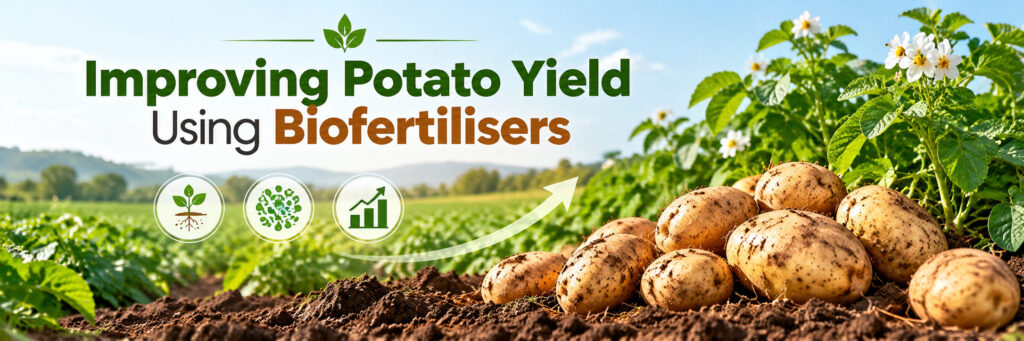
A healthy potato crop begins long before the first tubers are ready for harvest. Beneath the soil, roots are absorbing nutrients, microorganisms are interacting with the plant, and soil conditions are influencing how efficiently the crop grows. While healthy foliage is an encouraging sign, the real measure of successful potato cultivation lies in the development, size and quality of the tubers.
Potato is a nutrient-demanding crop that requires a balanced supply of nitrogen, phosphorus, potassium and other essential nutrients throughout its growing cycle. However, the availability of these nutrients depends not only on fertiliser application but also on soil conditions and biological activity.
This is where biofertilisers can play an important role. By introducing beneficial microorganisms into the crop’s growing environment, suitable biofertilisers can help improve nutrient availability and support plant growth. For us, this represents an important part of a broader approach to sustainable potato cultivation, where soil health and crop nutrition work together to support productivity.
1. Improving Nutrient Availability for Better Tuber Development
We begin with nutrient availability because it has a direct connection with potato growth and yield formation.
Nitrogen supports leaf development and the formation of the plant canopy, while phosphorus contributes to energy transfer and root development. Potassium plays important roles in water regulation, enzyme activity and carbohydrate movement within the plant. All three nutrients are essential for healthy crop development.
Certain biofertilisers can complement this nutrient supply through the activity of beneficial microorganisms.
For example, phosphate-solubilising microorganisms can convert some forms of soil phosphorus that are otherwise poorly available into forms that plants can absorb more readily. This can help improve phosphorus availability around the root zone when suitable soil conditions and microbial activity are present.
Similarly, potassium-solubilising microorganisms can help release potassium from certain soil minerals, depending on the organism and the characteristics of the soil.
Improved nutrient availability can support the plant’s ability to maintain healthy growth and develop tubers. However, biofertilisers cannot provide every nutrient required by a potato crop, and their effectiveness depends on the soil’s existing nutrient reserves.
This is why we consider biofertilisers a complement to balanced fertilisation rather than a universal replacement for conventional nutrient sources.
2. Supporting Root Development and Nutrient Uptake
Before a potato plant can develop healthy tubers, it needs a functioning root system capable of absorbing water and nutrients from the surrounding soil.
Root development is influenced by several factors, including soil structure, moisture, nutrient availability and biological activity. Beneficial microorganisms can contribute to this process through different mechanisms.
Certain plant-growth-promoting bacteria produce compounds that influence root development, while others help plants access nutrients in the root zone. Mycorrhizal fungi can also form associations with plant roots, extending the effective area from which certain nutrients, particularly phosphorus, can be absorbed.
These interactions may help improve nutrient acquisition under suitable growing conditions.
For potato cultivation, this can be particularly relevant because the crop’s root system is relatively shallow and its nutrient requirements are substantial. Better access to available nutrients can support the development of a healthy plant throughout the growing season.
However, not every microbial product contains the same organisms or produces the same effects. Growers should select biofertilisers according to the crop, soil conditions and recommended application method rather than assuming that all products will deliver identical results.
3. Encouraging Healthy Plant Growth and Photosynthetic Activity
A potato plant’s leaves perform an essential function: they capture sunlight and convert it into chemical energy through photosynthesis.
The sugars produced during photosynthesis support plant growth and contribute to the development of underground tubers. Consequently, maintaining healthy foliage and an appropriate balance between vegetative growth and tuber development is important for crop productivity.
Biofertilisers can support this process indirectly by improving nutrient availability and, in some cases, influencing root growth and plant physiological activity.
For example, microorganisms that improve access to essential nutrients may help plants maintain healthy growth when nutrient availability is a limiting factor. Some plant-growth-promoting microorganisms can also influence root development and help plants respond to certain environmental stresses.
Nevertheless, biofertilisers do not directly guarantee increased photosynthesis or higher yields. Their benefits depend on whether the relevant nutrients or biological processes are limiting plant growth in the first place.
Adequate sunlight, irrigation, temperature management and balanced nutrition remain essential. When these factors are managed together, biofertilisers can form part of a more comprehensive strategy for supporting potato crop development.
4. Supporting Soil Health and Biological Activity
When we discuss sustainable crop production, we must look beyond the plants growing above the ground. The condition of the soil also influences how successfully a crop develops.
Healthy agricultural soils contain a diverse community of microorganisms that participate in nutrient cycling and the breakdown of organic matter. These biological processes help maintain the soil environment in which crops grow.
Suitable biofertilisers can contribute to this environment by introducing specific beneficial microorganisms that perform useful functions within the soil or around plant roots.
Depending on the microbial species and formulation, these functions may include nitrogen fixation, nutrient solubilisation and interactions that support plant growth.
However, it is important to distinguish between biofertilisers and organic amendments. Biofertilisers introduce beneficial microorganisms, whereas materials such as compost and well-decomposed organic matter can supply organic carbon and other nutrients while influencing soil structure.
Using appropriate organic amendments alongside biofertilisers and a balanced fertilisation programme can support a broader soil-health strategy. The suitability of each input depends on the crop’s requirements, soil conditions and local agricultural recommendations.
For potato growers, maintaining a productive soil environment is an important consideration for both current crop performance and the long-term management of cultivated land.
5. Supporting Tuber Size, Quality and Overall Yield
Ultimately, the purpose of improving potato cultivation is to produce a healthy, marketable harvest.
Potato yield depends on several interacting factors, including the number of tubers formed, their average size, the variety being cultivated, planting material, water availability, nutrient management and pest and disease pressure.
Biofertilisers may contribute to yield improvement when they address a limiting factor, such as poor availability of a particular nutrient or inadequate biological activity around the roots.
For example, field research on potato cultivation has investigated combinations of nitrogen-fixing microorganisms, phosphorus-solubilising bacteria and conventional fertilisers. Such studies demonstrate why the interaction between biological inputs and mineral nutrition deserves attention when developing crop-management strategies.
However, results vary with the microbial strain, application method, soil type, climate and fertiliser programme. An increase in yield observed under one set of experimental conditions should not automatically be expected in every field.
It is also important to distinguish between total harvested yield and marketable yield. Producing more tubers does not necessarily mean that all of them will meet the required size and quality standards.
For this reason, growers should evaluate biofertiliser performance through suitable field observations, including plant growth, tuber development, harvested yield and marketable quality.
A well-planned programme focuses on consistent crop development rather than relying on a single input to determine the final harvest.
6. Integrating Biofertilisers into a Potato Nutrition Programme
We believe that effective crop nutrition begins with understanding the crop’s requirements and the condition of the soil.
Biofertilisers are most useful when they are selected and applied as part of a planned nutrient-management programme. Their effectiveness can be influenced by microbial survival, soil moisture, temperature, pH, application timing and compatibility with other agricultural inputs.
A practical approach can include:
- Before planting: Assess soil fertility, pH and nutrient availability. Select suitable planting material and identify any nutrient deficiencies that need to be addressed.
- At planting: Apply the selected biofertiliser according to its label instructions and recommended method. Depending on the formulation, this may involve seed-tuber treatment, soil application or another approved method.
- During early growth: Monitor plant establishment, root development and foliage. Maintain suitable soil moisture to support crop growth and microbial activity.
- During tuber initiation and development: Ensure that nitrogen, phosphorus, potassium and other essential nutrients remain available in appropriate quantities. Avoid assuming that biofertilisers alone can meet the crop’s nutrient requirements.
- Throughout the growing season: Monitor crop health, irrigation, pest and disease pressure, and other factors that influence yield. Follow product-specific recommendations and seek local agronomic guidance when required.
- After harvest: Assess total yield, marketable tuber size and quality. Record field performance to help determine whether the selected biofertiliser programme is beneficial under local conditions.
This stage-based approach allows biofertilisers to complement conventional fertilisers, organic inputs and sound crop-management practices without compromising the potato plant’s essential nutritional requirements.
7. Choosing the Right Biofertiliser for Potato Crops
Not all biofertilisers perform the same function. Choosing the right product begins with understanding which nutrient or biological process needs attention.
Nitrogen-fixing microorganisms can contribute biologically fixed nitrogen under suitable conditions, although the amount available to a potato crop varies and should not be assumed to replace its nitrogen requirement.
Phosphate-solubilising microorganisms may improve access to certain forms of soil phosphorus, while potassium-solubilising microorganisms can help mobilise potassium from particular mineral sources. Mycorrhizal products may also be useful in suitable production systems, depending on soil conditions and the compatibility of the fungal species with the crop.
When selecting a product, growers should consider the declared microbial strain, viable microbial count, product quality, storage requirements, expiry date and recommended application method.
Soil testing and advice from a qualified agricultural professional can help identify which inputs are appropriate. The aim is to select a biofertiliser that addresses an actual crop or soil requirement instead of applying microbial products without a clear purpose.
At NBCL, we recognise the importance of integrating appropriate fertiliser solutions into crop-specific nutrient-management programmes. Our portfolio includes organic, bio and chemical fertilisers, alongside other crop-nutrition products, supporting a broader approach to agricultural productivity and soil management.
The selection of any particular product should always be based on its formulation, intended use and the needs of the crop.
Growing Beyond the Harvest
For us, improving potato yield begins with understanding the relationship between the plant, the soil and the nutrients that support growth.
Biofertilisers offer an important opportunity to work with beneficial microorganisms that contribute to nutrient cycling and plant development. When selected carefully and used alongside balanced fertilisation, suitable irrigation and effective crop management, they can support efforts to improve nutrient-use efficiency and maintain productive agricultural soils.
However, successful potato cultivation does not depend on any single input. It requires an integrated approach that considers the crop’s nutritional needs at every stage, from planting and root establishment to tuber development and harvest.
At NBCL, we believe that sustainable agricultural productivity is built through informed nutrient management, suitable fertiliser choices and an understanding of the conditions in which crops grow.
By combining appropriate biofertilisers with sound agronomic practices, farmers can take a more considered approach to soil health, crop development and harvest quality, working towards productive farming systems that support both present needs and long-term agricultural sustainability.