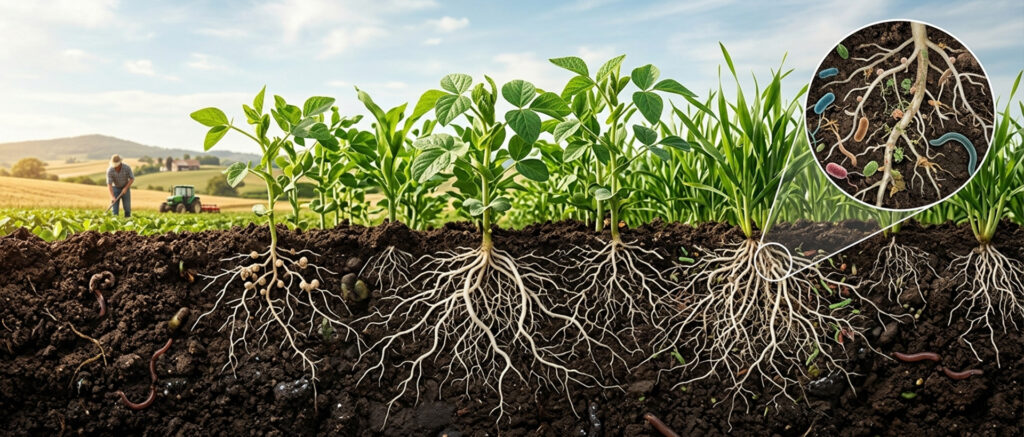
Modern agriculture depends heavily on the health of the soil beneath the crop. While fertilisers provide nutrients directly to plants, healthy soil systems do much more than simply hold roots in place. They regulate water movement, support microbial life, recycle nutrients, and influence how efficiently crops absorb what they need to grow. Among the most important biological relationships in soil is the partnership between plant roots and mycorrhizal fungi. Mycorrhiza biofertilisers are designed to strengthen this relationship and improve the natural efficiency of crop nutrition.
Mycorrhiza refers to a symbiotic association between certain beneficial fungi and plant roots. These fungi colonise the root system and extend far into the surrounding soil through microscopic thread-like structures known as hyphae. In exchange for small amounts of carbohydrates from the plant, the fungi help the crop absorb nutrients and water more effectively. This partnership has existed in nature for millions of years and continues to play a major role in plant health across both natural ecosystems and agricultural land.
As modern farming systems have become more intensive, the biological quality of soil has often declined. Repeated cultivation, imbalanced fertiliser use, and low organic matter can reduce microbial diversity in the root zone. Mycorrhiza biofertilisers attempt to restore part of this natural biological activity by reintroducing beneficial fungal populations into the soil environment. Their purpose is not to replace conventional fertilisers entirely, but to improve how efficiently crops use available nutrients and moisture.
How Mycorrhiza Functions in the Soil
The primary advantage of mycorrhiza lies in the extension of the plant’s effective root system. Plant roots can only access nutrients and water that lie close to the root surface. Mycorrhizal fungi expand this reach considerably by growing outward into areas of soil that roots alone cannot efficiently explore.
This becomes especially important for nutrients such as phosphorus, zinc, and potassium, which often remain fixed in the soil and move very slowly toward plant roots. The fungal network absorbs these nutrients and transports them back to the crop in forms that are easier for plants to utilise. As a result, nutrient uptake efficiency improves, particularly in soils where nutrient availability is limited.
Mycorrhiza also contributes to improved water absorption. Under dry conditions, fungal hyphae can access moisture from small soil pores that roots cannot reach directly. This helps crops tolerate periods of moisture stress more effectively. In regions where irregular rainfall and water scarcity are becoming increasingly common, stronger root-zone resilience is an important agricultural advantage.
Another significant benefit is improved root development. Crops with active mycorrhizal associations often develop larger and healthier root systems, which further strengthen nutrient uptake and plant stability. Over time, this biological activity contributes to better soil structure and improved microbial balance in the rhizosphere, the narrow region of soil surrounding plant roots.
The Role of Biofertilisers in Sustainable Agriculture
The growing interest in biofertilisers reflects a broader shift towards more sustainable agricultural practices. Farmers today face multiple pressures, rising fertiliser costs, declining soil fertility, unpredictable weather conditions, and the need to maintain productivity while reducing environmental stress. Biological solutions are increasingly being integrated into nutrient management programmes to address these challenges.
Biofertilisers work by supporting natural biological processes rather than relying solely on direct chemical inputs. They improve nutrient cycling, stimulate microbial activity, and help make existing soil nutrients more available to crops. This approach supports long-term soil productivity while reducing excessive dependence on synthetic fertilisers.
Mycorrhiza biofertilisers are particularly valuable because they complement other nutrient management strategies effectively. They can be used alongside organic matter additions, conventional fertilisers, micronutrient applications, and irrigation programmes. Their function is supportive and synergistic rather than competitive.
In practice, successful nutrient management often depends on combining multiple approaches rather than depending exclusively on one input category. Biological products contribute to this balance by improving the efficiency of the overall system.
How Narmada Bio-chem Limited Supports Soil Health Programmes
Narmada Bio-chem Limited offers a range of biological and nutrient management solutions designed to support integrated farming systems. The company’s portfolio includes products that contribute to microbial activity, nutrient availability, and root-zone development across different crop conditions.
Products such as BIO NPK help improve the availability of major nutrients through beneficial microbial activity. BIO KMB supports potassium mobilisation within the soil, helping crops access potassium reserves more efficiently. BIO-ZSB assists with zinc solubilisation, improving the availability of an important micronutrient that influences plant growth and enzyme activity.
BIO-ENRICHED formulations contribute additional biological support by enhancing microbial populations in the soil environment. MULADHAR focuses specifically on root-zone strengthening and soil biological activity, helping crops establish healthier root systems during early growth stages.
Together, these products reflect a broader integrated approach to nutrient management. Rather than treating soil as an inert growing medium, biological programmes recognise soil as a living ecosystem that must remain active and balanced to sustain productivity over time.
Narmada Bio-chem Limited’s product range is designed to work across diverse cropping systems and soil conditions. This flexibility is important because agricultural environments vary significantly between regions, crops, and climate conditions. Effective nutrient management programmes must therefore adapt to local soil characteristics and farming practices.
Mycorrhiza and Crop Performance
The benefits of mycorrhiza are visible across a wide range of crops, including cereals, pulses, oilseeds, fruits, vegetables, plantation crops, and horticultural systems. Crops with stronger root development generally establish more quickly, absorb nutrients more efficiently, and tolerate environmental stress more effectively.
In phosphorus-deficient soils, mycorrhizal activity becomes particularly valuable because phosphorus is one of the least mobile nutrients in agricultural systems. Even when phosphorus fertilisers are applied, much of the nutrient may become fixed within the soil and unavailable to plants. Mycorrhiza helps overcome this limitation by extending nutrient access beyond the immediate root zone.
The fungal association also contributes to improved soil aggregation. Certain fungal compounds help bind soil particles together, improving structure and reducing erosion risk. Better soil structure supports water infiltration, aeration, and long-term root development factors that influence crop productivity throughout the growing season.
Importantly, the benefits of biological systems tend to accumulate gradually. Unlike quick-response fertiliser applications, improvements in soil biology develop progressively through consistent management practices. Farmers who invest in biological soil health programmes are therefore building long-term productivity rather than focusing only on immediate seasonal output.
The Importance of Balanced Nutrient Management
While biological products offer important advantages, they work best as part of a balanced nutrient management programme. Crops still require sufficient quantities of nitrogen, phosphorus, potassium, and micronutrients to achieve healthy growth. Biological systems improve nutrient efficiency, but they cannot compensate indefinitely for severe nutrient deficiencies or poor soil management practices.
This is why integrated nutrient management remains essential. Organic inputs, mineral fertilisers, biological products, crop rotation, and proper irrigation management all contribute to overall soil performance. When these systems work together effectively, crops benefit from both immediate nutrient availability and long-term soil resilience.
Farmers increasingly recognise that sustainable productivity depends not only on adding nutrients, but also on maintaining the biological processes that allow soil to function properly. Healthy microbial activity, strong root systems, and balanced nutrient cycling are central to this objective.
Conclusion
Mycorrhiza biofertilisers represent an important step towards more biologically balanced agriculture. By strengthening the natural partnership between plant roots and beneficial fungi, they improve nutrient uptake, support root development, and contribute to better soil health over time.
As agricultural systems face growing pressure from climate variability, soil degradation, and rising input costs, biological approaches are becoming increasingly relevant. They help farmers improve efficiency while protecting the long-term productivity of the land.
Companies such as Narmada Bio-chem Limited contribute to this transition by developing products that support integrated nutrient management and soil biological activity. Solutions including BIO NPK, BIO KMB, BIO-ENRICHED, BIO-ZSB, and MULADHAR demonstrate how biological inputs can complement conventional agricultural practices and strengthen crop performance from the roots upward.