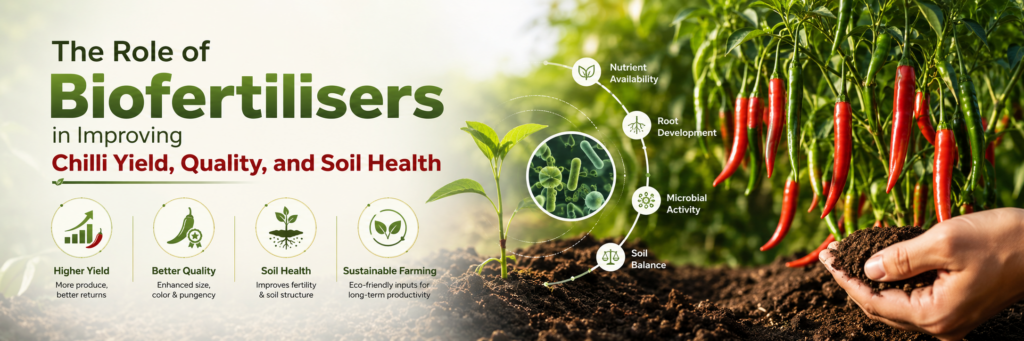
Chilli is an important spice and vegetable crop valued for its flavour, colour, pungency and wide range of culinary and commercial applications. In our experience, achieving consistently strong chilli yields depends on more than simply supplying plants with basic nutrients. Healthy roots, balanced nutrition, efficient nutrient uptake and good soil health all play an important role in crop performance.
This is where we see biofertilisers playing an important role. Biofertilisers contain beneficial microorganisms that help improve nutrient availability and support plant growth. When we use them as part of an integrated nutrient-management programme alongside appropriate organic and mineral fertilisers, they can contribute to better nutrient-use efficiency and long-term soil fertility. Nitrogen-fixing, phosphate-solubilising, potassium-mobilising and zinc-solubilising microorganisms are important components of biofertiliser technologies.
For chilli growers, we offer products such as Bio NPK, Potassium Mobilising Bacteria (KMB), Zinc Solubilising Bacteria (ZSB), Azotobacter, Azospirillum, Phosphate Solubilising Bacteria (PSB) and Muladhar, our mycorrhizal-based biofertiliser. These products give growers a range of biological tools that can be incorporated into a broader nutrient-management strategy.
What are Biofertilisers
Biofertilisers are agricultural inputs containing beneficial microorganisms that support nutrient cycling and improve the availability of nutrients to plants. We use different microorganisms for different functions, depending on the crop requirement and the nutrient-management objective.
For example, nitrogen-fixing bacteria can help convert atmospheric nitrogen into forms that plants can use, while phosphate-solubilising bacteria help make otherwise less-available phosphorus more accessible. Potassium- and zinc-solubilising microorganisms similarly support the mobilisation of these nutrients in the soil.
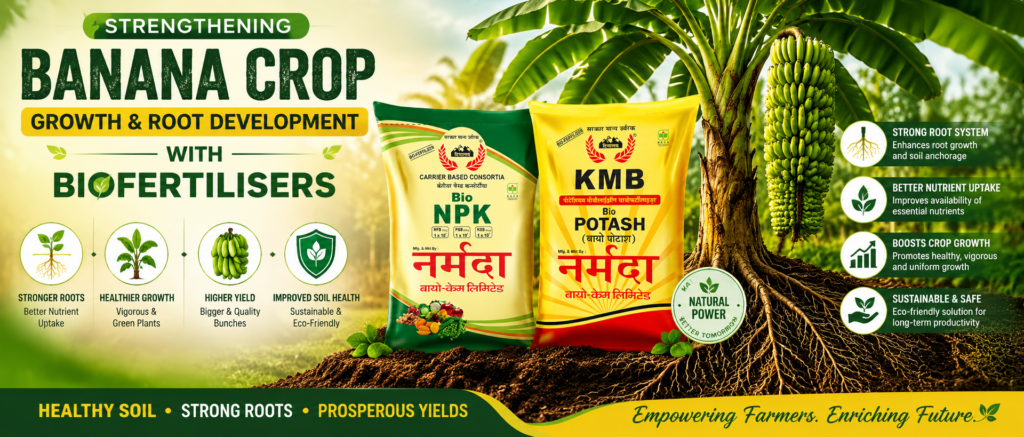
Our Bio NPK combines nitrogen-fixing, phosphate-solubilising and potassium-mobilising bacteria. We formulate this multi-nutrient biofertiliser to support nutrient availability and plant development, including seed germination, plant growth, water-holding capacity, and the colour and shelf life of fruits and vegetables. For chilli cultivation, this broad nutrient-support approach can complement crop nutrition from establishment through vegetative growth, flowering, fruit development and harvesting.
We see this multi-nutrient approach as particularly relevant to chilli, where balanced nutrition is important from establishment through vegetative growth, flowering, fruit development and harvesting.
1. Supporting Stronger Root and Plant Growth
A healthy root system is fundamental to successful chilli cultivation. Strong roots allow plants to explore a greater volume of soil and access water and nutrients more effectively. Because phosphorus plays a key role in root development, we consider Muladhar, our mycorrhizal-based biofertiliser, a particularly relevant biological input when the objective is to support stronger root establishment and nutrient uptake.
Muladhar is based on mycorrhizal technology that works around the root zone, while other beneficial microorganisms can also contribute to nutrient availability and overall plant development. By supporting the biological activity around the roots, we can help create a more favourable rhizosphere for nutrient and water uptake.
We also offer Azotobacter and Azospirillum as biological inputs within an integrated nutrient-management programme. Azospirillum is recognised as an option for seed treatment and seedling treatment in chilli cultivation, making it relevant during crop establishment.
2. Improving Nutrient Availability
One of the major advantages of biofertilisers is their ability to help unlock nutrients that may already be present in the soil but are not readily available to plants. Our Bio NPK is designed to support this nutrient-availability approach by combining nitrogen-fixing, phosphate-solubilising and potassium-mobilising bacteria in one product.
Phosphorus, for example, can become fixed in soil and consequently less accessible to crops. Phosphate Solubilising Bacteria (PSB) can help solubilise less-available forms of phosphorus. Similarly, potassium-mobilising microorganisms can convert insoluble forms of potassium into more available forms. By supporting these biological processes, we can help improve nutrient availability as part of a balanced crop nutrition programme.
Our Bio KMB is formulated with potassium-mobilising bacteria and is designed to help convert insoluble potassium into an available form. We list it for fruits and vegetables, spices and horticultural crops, making it relevant to chilli cultivation.
Better nutrient availability can support important stages of chilli development, including vegetative growth, flowering and fruit formation.
3. Supporting Chilli Fruit Quality
We recognise that chilli quality is influenced by several factors, including nutrition, water availability, crop health and growing conditions. We also see potassium as particularly important during fruit development because it can contribute to several aspects of crop quality.
Our Potassium Mobilising Bacteria product is designed to help improve the size, shape, sugar content and pigmentation of fruits and vegetables while also supporting shelf life. Its listed crop applications include vegetables and spices, making it a useful component of a broader biological nutrient-management strategy for chilli.
By improving potassium availability through biological mobilisation, we can complement broader nutrient-management practices and help plants access potassium already present in the soil.
4. Making Zinc More Available
We consider micronutrients essential for healthy plant growth even though crops require them in smaller quantities than primary nutrients. Zinc, in particular, plays a role in several physiological processes, including enzyme activity, plant growth and development.
Our Zinc Solubilising Bacteria (ZSB) helps convert insoluble zinc into a soluble form. We position ZSB as a biological input that supports plant growth, photosynthetic activity, protein and carbohydrate synthesis and stress tolerance. The product is also listed for vegetables, spices and horticultural crops.
For chilli growers, we see improving zinc availability as an important part of a balanced micronutrient-management strategy, particularly where soil or crop assessments indicate a requirement.
5. Building Long-Term Soil Health
The benefits of biofertilisers extend beyond the immediate crop. We believe that maintaining an active and balanced soil microbial environment is an important part of sustainable agriculture.
We recommend integrating biofertilisers with organic manures and other fertilisers as part of integrated nutrient management to support sustained crop production and long-term soil health. We see microbial biofertilisers as one of the tools that can contribute to better nutrient-use efficiency, soil fertility and sustainable crop production.
We also offer organic fertiliser products such as Bhoomandal (Fermented Organic Manure), Bio Gold, PROM and Power Phos, which can complement a broader soil-health programme where appropriate.
Combining organic matter management with suitable microbial inputs can help create a more favourable environment for root activity and nutrient cycling. For root-focused biological support, Muladhar can also form part of this integrated approach.
6. Integrating Biofertilisers into Chilli Cultivation
We do not view biofertilisers simply as a replacement for every other fertiliser. Their greatest value comes from using them as part of an integrated approach based on soil conditions, crop requirements and recommended nutrient doses.
Based on crop needs and soil conditions, we suggest a practical chilli nutrition programme that may include:
- Before planting: Assess soil fertility and address major nutrient deficiencies based on soil-test recommendations.
- At establishment: Use appropriate microbial products according to product directions.
- During crop growth: Consider nutrient-specific products such as Bio NPK, PSB, KMB and Muladhar where appropriate.
- During flowering and fruit development: Pay particular attention to balanced potassium and micronutrient availability, while maintaining suitable root-zone conditions.
- Throughout the season: Maintain soil organic matter, appropriate irrigation and good crop-management practices.
We provide specific application methods and dosage recommendations for our individual products. These instructions should be followed carefully rather than applying a generic dosage across different biofertilisers. For example, our liquid Bio NPK, KMB and ZSB products have specific application methods covering soil application, drip use, root dipping and foliar application.
A More Sustainable Approach to Chilli Production
We believe improving chilli productivity is not simply about increasing the quantity of fertiliser applied. It is about making nutrients available at the right time, supporting healthy root development, maintaining soil fertility and managing the crop according to its changing nutritional needs. We believe the strongest results come from combining sound agronomic practices with the right biological and nutrient-management inputs.
We offer a range of biofertiliser solutions, including Bio NPK, Bio KMB, Zinc Solubilising Bacteria, Azotobacter, Azospirillum, PSB and Muladhar, our mycorrhizal-based biofertiliser. Together, these products provide growers with different biological tools that can be incorporated into an integrated nutrient-management programme.
For chilli cultivation, our objective is to support a balanced system: healthy soil, active roots, efficient nutrient uptake and appropriate crop nutrition. With soil testing, good agronomic practices and the responsible use of suitable biofertilisers, we can help growers work towards improved chilli yield and quality while supporting the long-term health of their soil.