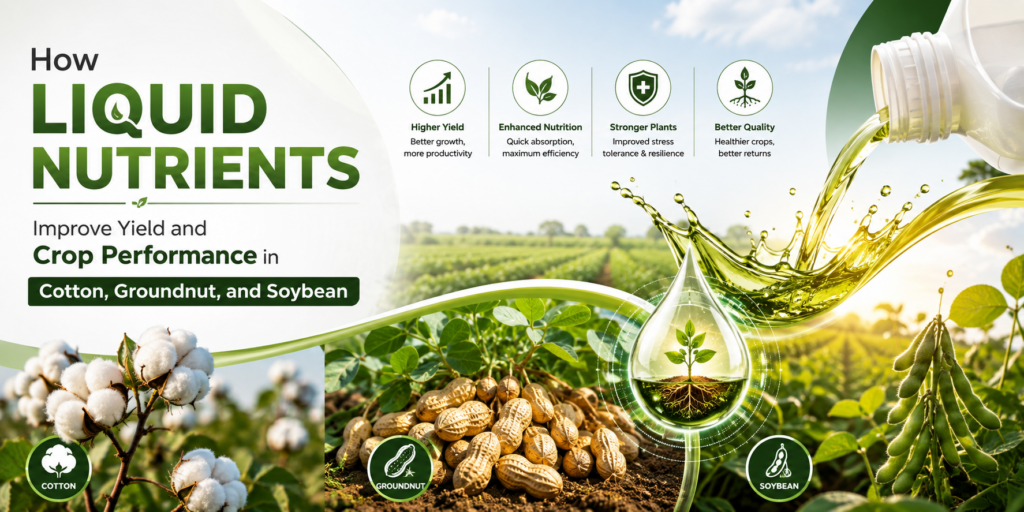
Cotton, groundnut and soybean are economically important crops, and each crop needs balanced nutrition at different stages of growth. At Narmada Bio-Chem, we believe liquid nutrition should be considered as part of a well-planned crop nutrition programme not as a substitute for sound soil and crop management, but as a practical way to support nutrient delivery when and where the crop needs it.
With our Narmada NewTrient range of liquid fertilisers, we focus on the practical side of crop nutrition: convenient application, compatibility with suitable irrigation and fertigation practices, and the ability to deliver nutrients at important stages of crop development. Our approach is to help growers manage nutrient availability, crop vigour and yield potential through timely and balanced nutrition.
What are Liquid Nutrients
Liquid nutrients are agricultural fertiliser formulations supplied in liquid form. Depending on the product and the recommendation, they can be applied through soil application, fertigation, drip irrigation or foliar spraying. This flexibility is one of the key reasons we see liquid fertilisers as a useful part of modern crop nutrition.
At Narmada Bio-Chem, we position our Narmada NewTrient range around this practical advantage. Instead of treating nutrition as a single application, we encourage growers to consider the nutrient requirement of the crop, the soil condition and the stage of crop development before selecting an appropriate liquid fertiliser and application method.
Why Liquid Nutrition Matters for Crop Performance
Plants do not have the same nutrient requirement throughout the season. Demand changes from germination and vegetative growth to flowering, reproductive development and final yield formation. We therefore see timing as an important part of effective nutrition.
Liquid fertilisers can fit into these different stages through suitable irrigation, fertigation or foliar application. This can help growers incorporate nutrition into their existing crop-management practices without viewing liquid fertilisers as a one-time input.
We also recommend keeping liquid nutrition connected to the fundamentals of crop management. Soil testing, recommended fertiliser doses, irrigation, pest and disease management and sound agronomic practices remain essential. Our objective is to complement these practices with appropriate liquid nutrition.
Liquid Nutrition in Cotton
Cotton has a relatively long crop cycle, and its nutrient requirements change from establishment and vegetative growth to flowering, boll formation and boll development. We therefore recommend looking at liquid nutrition in relation to these stages rather than applying the same approach throughout the season.
Supporting Early Growth
Strong establishment and healthy vegetative development provide the foundation for productive cotton plants. Nitrogen is important during vegetative growth, but balanced nutrition is essential because excessive vegetative growth can work against reproductive development.
At Narmada Bio-Chem, we use the Narmada NewTrient range to support a stage-based approach to liquid fertilisation. Where a liquid nutrient is recommended during early crop growth, the formulation and application should be selected according to the crop requirement, soil condition and product directions.
Supporting Flowering and Boll Development
As cotton enters flowering and boll formation, balanced nutrition becomes increasingly important. Potassium, for example, is associated with water regulation and plant stress responses, making appropriate nutrient management relevant during these stages.
We recommend using liquid nutrition as part of a crop-specific programme, with the timing and method of application aligned to the crop stage. Foliar application, fertigation or drip application may be suitable depending on the formulation and the recommendation being followed.
The principle is straightforward: we should not treat liquid fertilisation as a single event. By matching nutrition with crop demand, we can work towards better nutrient-use efficiency and improved crop performance.
Liquid Nutrition in Groundnut
Groundnut is both an oilseed and a leguminous crop, with important nutritional requirements during vegetative growth, flowering, peg formation and pod development. We therefore consider stage-specific nutrition particularly important in groundnut.
Supporting Root and Vegetative Development
Healthy root development and effective nutrient availability are important during early groundnut growth. Phosphorus plays an important role in legume production, while balanced potassium and micronutrient nutrition also contribute to crop performance.
Our approach is to use the Narmada NewTrient range where an appropriate liquid fertiliser can complement the crop nutrition programme. Selection should be based on the nutrient requirement of the crop, the condition of the soil and the recommended application stage.
Supporting Flowering, Peg and Pod Formation
Groundnut yield depends on successful flowering, peg formation and pod development. Adequate nutrient availability during these stages is therefore essential.
ICAR crop recommendations demonstrate the importance of stage-specific nutrition in groundnut, including potassium management and foliar micronutrient application. We see these recommendations as a reminder that nutrient timing matters as much as nutrient quantity.
By integrating suitable liquid fertilisers into irrigation or foliar application programmes, growers can manage nutrition in line with crop demand. The objective is not simply to add more fertiliser, but to improve the timing and availability of the nutrients required by the crop.
Liquid Nutrition in Soybean
Soybeans have significant nutritional requirements during establishment, vegetative development, flowering and pod formation. As a leguminous crop, its nitrogen requirement also needs to be considered within the broader crop nutrition programme.
Supporting Healthy Vegetative Growth
We recommend starting with the basics: good soil fertility, suitable fertiliser doses and the right nutrient balance for the crop. Where liquid nutrition is appropriate, our Narmada NewTrient range can be incorporated into the programme according to the formulation, crop stage and application recommendation.
The selection of a liquid fertiliser should always be based on the crop requirement and growing conditions. We do not recommend assuming that the same product or application schedule will suit every field or every stage of soybean development.
Supporting Flowering and Pod Development
The transition from vegetative growth to flowering and pod formation is a critical period for yield determination. Adequate phosphorus and potassium availability can support the crop’s changing nutritional requirements during this phase.
We encourage growers to use stage-based nutrient management, incorporating liquid fertilisers where appropriate through foliar application, fertigation or drip irrigation. When nutrition is timed with crop demand, it becomes easier to manage nutrient availability as the crop moves towards reproductive development.
The Role of Micronutrients
Macronutrients are only one part of complete crop nutrition. Micronutrients also influence important physiological processes, and their availability should be considered when planning a balanced fertilisation programme.
At Narmada Bio-Chem, we recommend beginning with soil testing and professional agronomic guidance wherever micronutrient supplementation is being considered. A liquid micronutrient fertiliser should be selected according to the identified requirement, the crop stage and the recommended method of application.
Advantages of Liquid Fertilisers
When appropriately selected and applied, liquid fertilisers can offer practical advantages within an integrated crop nutrition programme:
- Easy application: Liquid formulations can be incorporated into suitable irrigation, fertigation or foliar application programmes.
- Flexible timing: Liquid nutrition can be scheduled around crop stage and nutrient demand.
- Targeted nutrition: The formulation can be selected according to the nutrient requirement identified for the crop and field.
- Efficient integration: Liquid fertilisers can complement conventional fertiliser practices and other agronomic inputs.
- Practical handling: Because the formulation is supplied in liquid form, it can be convenient for suitable application systems, subject to product instructions and equipment compatibility.
Our focus with the Narmada NewTrient range is therefore not simply on the liquid format itself. It is on using that format responsibly to support a more timely and practical nutrient-management programme.
Best Practices for Using Liquid Nutrients
The effectiveness of liquid nutrition depends heavily on correct selection and application. We recommend that growers consider the following:
- Test the soil to identify nutrient deficiencies and understand the condition of the soil.
- Select the liquid fertiliser according to the crop and its nutritional requirements.
- Apply at the recommended crop stage rather than using a one-size-fits-all schedule.
- Follow the manufacturer’s dosage, application and storage instructions.
- Use suitable water quality and appropriate application equipment.
- Avoid unverified combinations with pesticides, herbicides or other fertilisers where the product label advises against mixing.
- Maintain irrigation, crop protection and other good agronomic practices alongside liquid nutrition.
We also recommend paying close attention to compatibility and application guidance for every product. Liquid fertilisers should be handled and stored as specified by the manufacturer, and the recommended application route such as soil application, drip, fertigation or foliar spray should be followed carefully.
Towards More Efficient Crop Nutrition
Cotton, groundnut and soybean have different growth patterns and nutrient requirements, but they share one fundamental need: efficient access to balanced nutrition throughout the crop cycle.
At Narmada Bio-Chem, we see our Narmada NewTrient range of liquid fertilisers as one practical component of that broader approach. By considering soil condition, crop stage, nutrient requirement and the right application method, growers can make liquid nutrition part of a more disciplined crop-management strategy.
The most effective strategy is not simply to increase fertiliser use. It is to improve nutrient-use efficiency, timing and availability. When liquid nutrition is supported by soil testing, balanced fertilisation, appropriate irrigation and sound agronomic practices, we can work towards healthier crops, stronger growth and improved yield potential.