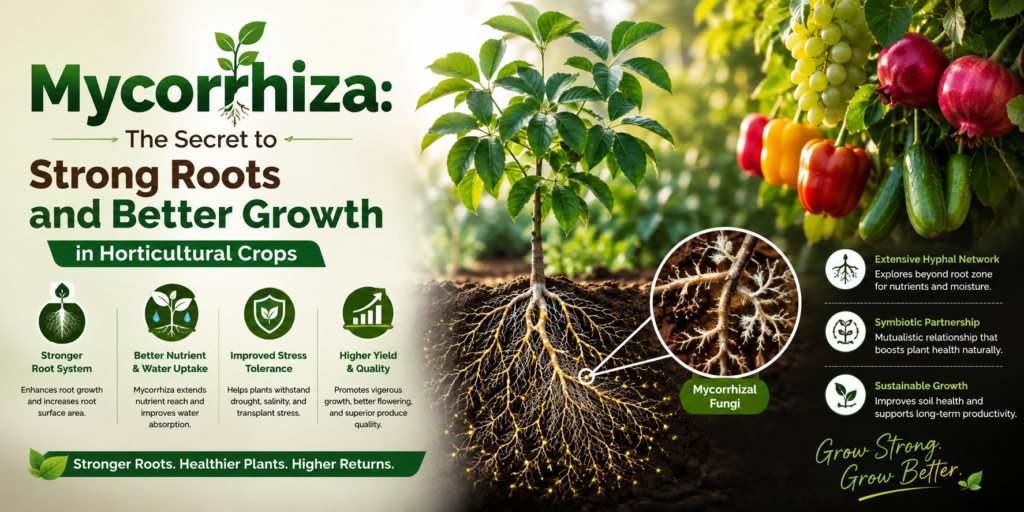
Healthy roots are the foundation of productive horticultural crops. Whether we are talking about chilli, tomato, banana, pomegranate, citrus, capsicum or cucurbits, strong root development plays a major role in how effectively plants access water and nutrients from the soil. Even when nutrients are present, plants may not always be able to access them efficiently.
This is where we see an important role for mycorrhiza.
Mycorrhiza is a mutually beneficial association between certain fungi and plant roots. The fungal network extends beyond the immediate root zone, increasing the area of soil explored by the plant. This can support nutrient and water acquisition and help plants remain more resilient under challenging growing conditions.
At Narmada Bio-Chem, we view mycorrhiza as an important biological component of an integrated crop-nutrition programme. Through our Muladhar Mycorrhiza, we aim to support stronger roots, better nutrient exploration and healthier plants while complementing conventional fertilisers, organic inputs and other biological solutions.
What is Mycorrhiza
The word mycorrhiza comes from the Greek words for “fungus” and “root”. It describes a symbiotic relationship in which beneficial fungi associate with plant roots.
The plant supplies the fungus with carbon compounds produced through photosynthesis. In return, the fungal hyphae extend into the surrounding soil and help the plant access nutrients and water beyond the immediate reach of its roots.
We particularly value this extended fungal network for relatively immobile nutrients such as phosphorus. Agricultural research and guidance indicate that arbuscular mycorrhizal fungi (AMF) can enhance nutrient uptake by extending the effective reach of the root system and increasing the soil surface area available for nutrient absorption.
We also recognise an important soil-health dimension. Mycorrhiza produces glomalin, a glycoprotein associated with soil aggregation and structure. By contributing to soil structure and adding carbon to the soil, mycorrhiza can support not only nutrient availability but also broader soil health.
In practical terms, we look at mycorrhiza as a biological extension of the plant’s root system.
Why Strong Roots Matter in Horticultural Crops
Horticultural crops often have demanding production cycles. Fruit and vegetable crops need to establish quickly, develop sufficient foliage, flower successfully and produce fruits or other marketable parts with the required size and quality.
A strong root system helps plants:
- Explore a greater volume of soil
- Access water more efficiently
- Acquire nutrients from the surrounding soil
- Establish more effectively after planting or transplanting
- Maintain growth during periods of environmental stress
- Support above-ground vegetative and reproductive development
For us, this is central to horticultural nutrition because consistent root activity supports consistent crop growth. Our approach is to strengthen the root–soil relationship so that plants can make better use of the resources already available in their growing environment.
How Mycorrhiza Improves Nutrient Uptake
One of the most important benefits we associate with mycorrhiza is improved nutrient acquisition.
Phosphorus is relatively immobile in soil. Even when total soil phosphorus is high, only a portion may be readily available to plants. The external fungal hyphae associated with mycorrhizal roots can explore soil beyond the depletion zone around the root and contribute to phosphorus acquisition.
Research conducted on an okra–pea cropping system reported that AMF inoculation improved phosphorus-use efficiency and growth parameters. The study also reported that AMF combined with 75% of the soil-test-based phosphorus dose produced yields statistically similar to the full phosphorus dose under the conditions tested.
We do not interpret this as mycorrhiza eliminating the need for phosphorus fertilisation. Rather, we see it as evidence of why efficient nutrient utilisation can be an important part of integrated nutrient management.
Mycorrhiza and Water Availability
Water availability is another important consideration for horticultural crops. Plants experiencing water stress may struggle to maintain normal growth, flowering and fruit development.
Because mycorrhizal fungal networks extend beyond the immediate root zone, they can increase the effective soil volume explored by the plant. This can support water acquisition and contribute to plant resilience when water availability is limited.
Our approach is to view mycorrhiza as one component of a broader water-management strategy, alongside appropriate irrigation scheduling, soil organic matter management and good field practices.
Mycorrhiza in Chilli and Tomato
Chilli and tomato require strong establishment followed by vigorous vegetative growth, flowering and fruit development. Root health is important throughout this cycle.
For chilli, we recommend Muladhar Mycorrhiza during the vegetative stage alongside products such as our Bio NPK and Bio-ZSB, as part of a broader nutrient-management programme. For tomato, we similarly include mycorrhiza within the crop nutrition programme.
We believe mycorrhiza delivers its greatest value when it is incorporated into a complete crop-nutrition strategy rather than treated as an isolated input.
Our other biological products can complement this approach. Our Bio NPK is designed around nitrogen-fixing, phosphorus-solubilising and potassium-mobilising bacteria to support nutrient availability, while our Bio KMB is designed to help convert insoluble soil potassium into a more available form.
Together, these solutions allow us to address different aspects of nutrient availability around the root zone.
Supporting Banana and Fruit Crops
Perennial and long-duration horticultural crops need sustained attention to root-zone health.
In banana, effective nutrient management remains important throughout vegetative development, flowering and fruit formation. We include Muladhar Mycorrhiza during the plantation and flowering stages alongside products such as PROM, Bio NPK, Bio-Potash and Bio-ZSB.
For fruit crops such as pomegranate and citrus, our recommendations also incorporate Muladhar Mycorrhiza at different plant ages. In citrus, we combine mycorrhiza with organic and biological nutrient inputs, with applications divided into two periods each year.
Through these crop-specific programmes, we focus on maintaining root-zone nutrition throughout the life of perennial crops.
Mycorrhiza and Soil Health
For us, the benefits of mycorrhiza go beyond nutrient uptake. Mycorrhizal fungal networks can interact with soil particles and contribute to soil aggregation and structure.
We also consider glomalin an important part of this relationship. As a glycoprotein produced in association with mycorrhizal fungi, glomalin supports soil aggregation and contributes carbon to the soil. This means mycorrhiza can help us look at nutrient availability and soil health together rather than as separate objectives.
Our view is aligned with integrated nutrient management, where mineral fertilisers, organic inputs and biological products are used together to maintain productivity while supporting soil health.
Research on horticultural crops has also highlighted the value of combining biological inputs with balanced fertilisation. In a study on Dracaena marginata, for example, a combination involving vermicompost, VAM consortia and NPK improved growth performance and nutrient uptake compared with the control.
This reinforces our belief that productive horticulture starts with a healthy root zone and a well-managed soil environment.
Combining Mycorrhiza with Other Narmada Bio-Chem Products
Mycorrhiza works within a complex soil ecosystem, so we recommend considering it alongside the overall crop nutrition programme.
Our Power Phos is an organic phosphorus product designed to support root development, stem growth, initial flowering and seed formation. It also contains organic carbon, which can support soil microflora and nutrient mobilisation. The product is listed for vegetables and horticultural crops.
Our Bio KMB is designed to mobilise insoluble potassium and is listed for fruits, vegetables, ornamental plants and horticultural crops.
The principle is simple: strong roots need access to a balanced supply of nutrients and water. We use mycorrhiza to extend the plant’s nutrient-exploration capacity, while our other biological and organic inputs address specific aspects of nutrient availability and soil fertility.
By combining these tools according to crop need, soil condition and stage of development, we can build a more complete root-zone nutrition programme.
Best Practices for Using Mycorrhiza
To obtain the best possible results from mycorrhizal products, we recommend that growers:
- Apply mycorrhiza at the appropriate crop stage. Early root establishment and vegetative growth are particularly important for many horticultural crops.
- Place the product where it can interact with developing roots, following the manufacturer’s application instructions.
- Maintain suitable soil moisture to support root and microbial activity.
- Avoid unnecessary disturbance of the root zone after application.
- Use balanced fertilisation. Mycorrhiza complements rather than automatically replaces conventional fertilisers.
- Consider soil conditions and crop requirements before selecting a biological input.
- Follow the manufacturer’s recommended dosage and application method.
Our crop-specific recommendations show how Muladhar Mycorrhiza can be integrated with other products at different crop stages, including chilli, tomato, banana, pomegranate, citrus, capsicum, melons, cucurbits and garlic.
Building Better Horticultural Crops from the Soil Up
We believe higher horticultural productivity begins below the soil surface. A plant with a healthy and active root system is better positioned to access nutrients and water and support the growth of stems, leaves, flowers and fruits.
Mycorrhiza gives us a biological approach to strengthening this root–soil relationship. By extending the effective reach of roots, supporting nutrient acquisition and contributing to soil biological activity and soil structure, mycorrhizal fungi can become a valuable part of an integrated crop-nutrition programme.
Our goal is not simply to encourage growers to apply more fertiliser. We focus instead on better nutrient availability, efficient nutrient use, healthy roots and sustainable soil management.
Through Muladhar Mycorrhiza, together with complementary solutions such as our Bio NPK, Bio KMB and Power Phos, we provide options that can be incorporated into crop-specific nutrient-management programmes.
When combined with appropriate soil testing, irrigation, organic matter management and good agronomic practices, mycorrhiza can help create a healthier root environment and provide a stronger foundation for productive, quality-focused horticultural cultivation.