Unlike crops harvested mainly for leaves or fruits, ginger and turmeric accumulate much of their economic yield below the soil surface. We therefore pay close attention to the root and rhizome zone. A balanced supply of nitrogen, phosphorus, potassium and micronutrients, supported by healthy soil biology and adequate moisture, can help the crop develop vigorous foliage and well-formed rhizomes.
Research on ginger shows that nutrient management can influence yield and quality attributes, while studies on turmeric demonstrate the value of integrated nutrient management for improving soil quality, nutrient uptake and rhizome yield. We use this evidence to support a balanced, stage-wise approach rather than relying on a single nutrient or input.
This is where our biological nutrient-management solutions such as Bio NPK, Potassium Mobilising Bacteria (KMB), Zinc Solubilising Bacteria (ZSB) and Muladhar Mycorrhiza can complement a wider crop nutrition programme.
Why Nutrient Availability Matters in Ginger and Turmeric
We know that the presence of a nutrient in soil does not necessarily mean that it is immediately available to plants. Soil pH, moisture, organic matter, microbial activity and interactions between nutrients can all influence nutrient availability.
For ginger and turmeric, efficient nutrient uptake is particularly important because the crop must maintain healthy above-ground growth while progressively developing its rhizomes. We therefore focus on improving nutrient availability at the stages when the crop needs it most.
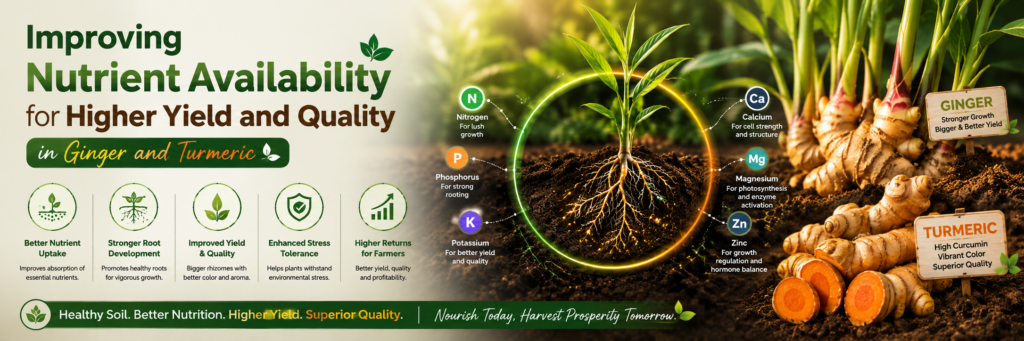
Nitrogen supports vegetative growth and leaf development. Phosphorus contributes to root development and energy-transfer processes, while potassium plays an important role in water regulation, enzyme activity and overall plant development. Micronutrients such as zinc are also required for several physiological functions.
Research on ginger has found that increasing N, P and K levels affected growth, rhizome yield and quality attributes, including ginger oil and oleoresin content, although the optimum requirement depends on the cultivar and growing conditions.
For us, the goal is not simply to apply more fertiliser. It is to help ensure that the right nutrients are available in usable forms at the appropriate stages of crop development.
The Role of Nitrogen in Rhizome Development
Ginger and turmeric need sufficient nitrogen to establish a healthy canopy. Leaves are essential for photosynthesis, which provides the energy and assimilates needed for subsequent rhizome development.
We also believe nitrogen management should remain balanced. Excessive nitrogen does not automatically translate into higher economic yield and can lead to excessive vegetative growth or inefficient nutrient use.
Research on turmeric has shown that nitrogen fertilisation combined with farmyard manure can increase rhizome and straw yields as well as phosphorus and potassium uptake.
Our Bio NPK provides a biological approach that combines nitrogen-fixing, phosphate-solubilising and potassium-mobilising bacteria. We position it as a way to support nutrient availability and overall plant growth, and the product is listed for spices, fruits and vegetables and horticultural crops.
For ginger and turmeric, we see Bio NPK as a potential component of an integrated nutrient-management programme, subject to soil conditions and recommended application practices. In a real crop situation, better nutrient availability can translate into stronger vegetative growth and a better nutritional foundation for subsequent rhizome development.
Phosphorus and Healthy Root Development
Phosphorus is particularly important during early crop establishment because it supports root development and energy-transfer processes. In ginger and turmeric, good early root growth provides the foundation for nutrient and water acquisition throughout the crop cycle.
However, some of the phosphorus present in soil can become fixed in forms that are less readily available to plants.
Biological nutrient-management products containing phosphate-solubilising microorganisms can help address this issue. Our Bio NPK contains Phosphate Solubilising Bacteria (PSB) alongside nitrogen-fixing and potassium-mobilising bacteria, and the PSB component helps solubilise complex forms of phosphorus. We can complement this approach with Muladhar Mycorrhiza, which supports the root–soil relationship and can help the plant explore a greater volume of soil for water and nutrients.
By improving the availability of existing nutrients and supporting the root zone, these biological inputs can complement conventional fertiliser management rather than simply increasing the total quantity of fertiliser applied.
Potassium: Supporting Rhizome Growth and Crop Quality
Potassium is particularly relevant to crops such as ginger and turmeric because it is involved in water regulation, enzyme activation and several processes associated with plant growth and stress response.
Research on ginger has specifically investigated potassium and farmyard manure in relation to yield, nutrient uptake and quality, highlighting the importance of potassium management in the crop.
Our Potassium Mobilising Bacteria (KMB) is designed to mobilise insoluble potassium into a more available form. We position KMB as a biological tool that can support potassium availability and crop performance, with the product listed for vegetables, spices and horticultural crops.
This approach is particularly relevant where potassium is present in the soil but its availability to plants is limited. In a practical crop situation, improved potassium availability can support the crop as it moves from vegetative growth towards rhizome development and bulking.
Importantly, we recommend using KMB as part of a broader potassium-management strategy and not as an automatic substitute for recommended potassium fertilisation.
Zinc and Micronutrient Availability
Although micronutrients are required in smaller quantities than nitrogen, phosphorus and potassium, they are essential for healthy crop development.
Zinc participates in enzyme activity, plant hormone production and other physiological processes. Deficiencies can affect plant growth and nutrient-use efficiency.
Our Zinc Solubilising Bacteria (ZSB) is formulated to convert insoluble zinc into a soluble form. We use this biological approach to support zinc availability and processes associated with plant growth, photosynthetic activity and the synthesis of proteins and carbohydrates. The product is listed for spices, vegetables, fruits and horticultural crops.
For ginger and turmeric growers, we recommend considering ZSB where zinc availability is a recognised concern. Soil testing and crop-specific recommendations should guide the decision to use additional zinc-related inputs. In the crop, better zinc availability can support healthier canopy activity and more efficient overall nutrient use.
Organic Matter and the Root-Zone Environment
We see nutrient availability as inseparable from soil health. Organic matter contributes to the physical, chemical and biological properties of soil and can support microbial activity and nutrient cycling.
Evidence from turmeric research is particularly relevant. A three-year study comparing organic, conventional and integrated nutrient management found that the integrated treatment produced higher average rhizome yield than either conventional or organic management alone. The integrated treatment also recorded higher uptake of several nutrients, including N, P, K, Mg and Zn, while supporting indicators of soil biological activity.
Another ICAR study on ginger found that combinations of organic nutrient sources performed better than individual organic sources for several growth, yield and quality parameters.
These findings reinforce an important principle that guides our approach: nutrient management works best as a system.
Improving Turmeric Yield and Quality
Turmeric yield is closely associated with rhizome development, while quality can be assessed through attributes such as curcumin, oleoresin and essential oil content.
Research conducted through ICAR found that pre-harvest soil management influenced the phytochemical concentration of turmeric rhizomes, demonstrating the connection between crop management and quality characteristics.
Another ICAR-published study found that integrated nutrient management was superior to conventional and organic nutrient management in terms of turmeric rhizome yield under the conditions tested.
For us, this reinforces the importance of maintaining balanced nutrition throughout the crop cycle so that growers can work towards both rhizome productivity and quality-focused cultivation.
Our biological products offer different mechanisms for supporting nutrient availability. Bio NPK addresses biological mobilisation of nitrogen, phosphorus and potassium, while Bio KMB focuses specifically on potassium mobilisation and Bio-ZSB on zinc availability. Muladhar Mycorrhiza adds a root-zone approach by supporting the root–soil relationship.
Improving Ginger Yield and Quality
Ginger also responds to balanced nutrient management. Its economic yield depends on the development of healthy, well-filled rhizomes, while quality attributes can include essential oil and oleoresin content.
An ICAR-published study on ginger found that a combination of organic nutrient sources improved several growth and yield characteristics, with one combination producing higher fresh and cured rhizome yields as well as improved oleoresin and essential oil content under the study conditions.
Another study found that higher N, P and K levels significantly increased several ginger growth, yield and quality attributes, although the appropriate nutrient rate depends on cultivar and production conditions.
This is why we approach ginger nutrition through soil testing, balanced fertilisation and stage-specific nutrient management rather than relying on a single input.
Managing Nutrients Through the Crop Cycle
We recommend a well-planned nutrient programme that reflects the changing needs of ginger and turmeric.
1. At Planting
At planting, our objective is to establish healthy roots and shoots. Organic matter and appropriate basal nutrition can help create a favourable soil environment. Products such as Power Phos and Bio Gold can be considered as part of this foundational soil and nutrient-management programme, in line with crop needs and recommended use.
2. During Vegetative Growth
During vegetative growth, the crop requires adequate nutrition to develop a healthy canopy. We consider this an appropriate stage for products such as Bio NPK and Muladhar, where recommended, to support nutrient availability and the root–soil environment. In practical terms, this can contribute to stronger vegetative growth and better preparation for rhizome development.
3. During Rhizome Development
As the crop directs more resources towards rhizome formation, potassium and other nutrients become increasingly important. We therefore consider KMB where appropriate to support potassium availability, while maintaining adequate soil moisture and overall balanced nutrition. In the field, this can support the crop during rhizome expansion and bulking.
4. During Crop Maturity
During crop maturity, we continue to focus on balanced nutrition until the crop reaches maturity, while adjusting irrigation and other crop-management practices according to the crop’s requirements.
The principle is simple: we manage nutrition around crop demand rather than following a fixed, one-time application approach.
Integrating Our Products into a Nutrient-Management Programme
At Narmada Bio-Chem, we offer a range of biological fertilisers that can be considered as components of an integrated nutrient-management programme. For ginger and turmeric, our relevant biological options include Bio NPK, Bio KMB, Bio-ZSB and Muladhar.
For these crops, we look at each product in terms of both its biological function and the crop outcome it can support:
For ginger and turmeric, we translate the role of each product into a practical crop objective: stronger vegetative growth, better root-zone activity, improved nutrient availability and more effective rhizome development.
- Bio NPK: Combines nitrogen-fixing, phosphate-solubilising and potassium-mobilising bacteria to support nutrient availability. In the crop, this can contribute to stronger vegetative growth and a better nutritional foundation for subsequent rhizome development.
- Bio KMB: Helps mobilise insoluble potassium into a more available form and is listed for spices and horticultural crops. In practice, improved potassium availability can support the transition into rhizome development, bulking and crop quality.
- Bio-ZSB: Helps solubilise insoluble zinc and supports processes associated with plant growth and photosynthesis. In a ginger or turmeric crop, this can support healthier canopy performance where zinc availability is limiting.
- Muladhar: Our mycorrhizal product can be considered where improving the root–soil relationship is part of the crop-management strategy. By supporting the effective root zone, Muladhar can help the crop access water and nutrients more efficiently and provide a stronger foundation for rhizome development.
These products are not interchangeable. Each has a different biological function, and we recommend selection based on soil conditions, crop requirements and professional agronomic recommendations.
Best Practices for Ginger and Turmeric Nutrition
For more efficient nutrient management, we recommend that growers:
- Conduct soil testing before developing the fertiliser programme.
- Use balanced NPK nutrition according to crop and soil requirements.
- Maintain adequate organic matter to support soil structure and biological activity.
- Consider nutrient-solubilising microorganisms where appropriate.
- Pay particular attention to potassium during rhizome development.
- Monitor micronutrient availability, particularly where deficiencies are known or suspected.
- Maintain appropriate soil moisture without creating conditions that favour rhizome diseases.
- Use healthy planting material, as disease-free planting material is important for crop establishment in both ginger and turmeric.
- Follow product labels carefully, including dosage, application method, storage and compatibility requirements.
Our product guidance specifies application methods according to the formulation, and growers should follow the recommended route, dosage, storage and compatibility instructions for each product.
Building a More Efficient Spice-Crop Nutrition Strategy
Higher ginger and turmeric yields are not achieved through a single nutrient or product. In our view, they depend on the interaction between healthy soil, balanced nutrition, strong roots, adequate moisture, healthy planting material and appropriate crop management.
Research on both crops supports the value of balanced and integrated nutrient management for improving productivity and nutrient uptake. In turmeric, integrated management has demonstrated benefits for rhizome yield and soil biological properties, while ginger research highlights the importance of balanced NPK and organic nutrient sources for yield and quality.
Our biological products can complement this approach by helping make nutrients more available to plants. Bio NPK, Bio KMB and Bio-ZSB provide different mechanisms for improving the availability of major and micronutrients, while Muladhar supports the root–soil relationship. Together, these can form part of a crop-specific nutrient-management programme.
Ultimately, we focus on nutrient availability, not simply nutrient application. With balanced nutrition and good agronomic practices, our solutions can support stronger rhizomes and consistent crop quality.