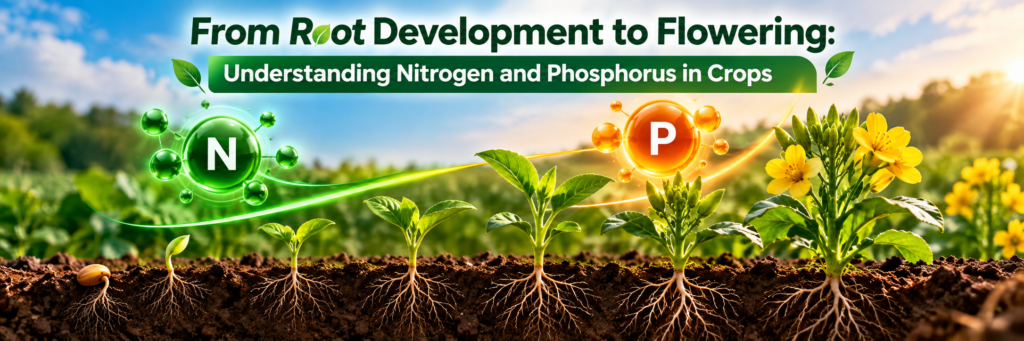
When we look at crop nutrition, nitrogen and phosphorus are two nutrients that play important roles from the earliest stages of plant development. While phosphorus is closely associated with root establishment and early growth, nitrogen supports vegetative development and the formation of healthy leaves and stems.
For us, good crop nutrition is not simply about supplying these nutrients in large quantities. It is about understanding what the crop needs at different stages and providing balanced nutrition throughout the crop cycle.
Our portfolio includes products such as Urea, SSP, DAP, PROM, Bio-NPK and other fertiliser solutions that can be integrated into crop-specific nutrient-management programmes. Our crop recommendations also demonstrate stage-wise fertiliser use across crops including paddy, maize, wheat, cotton, mustard, gram, potato, onion, chilli and tomato.
What Does Nitrogen and Phosphorus Do
When we discuss nitrogen, we focus mainly on vegetative growth. Nitrogen supports the development of leaves, stems and other plant tissues and is an important part of the plant’s overall growth process.
Phosphorus has a different but equally important role. It is involved in energy transfer and is particularly important during early plant development, including root establishment.
Nitrogen (N) and phosphorus (P) work together in a synergistic relationship where the presence of one nutrient boosts the plant’s ability to absorb and use the other.
This is why we see nitrogen and phosphorus as complementary nutrients. Strong early development can help establish the crop, while adequate nitrogen availability can support continued vegetative growth as the plant progresses towards flowering.
1. Supporting Strong Root Development
We begin with the root system because healthy roots provide the foundation for nutrient and water uptake.
Phosphorus is particularly important during early crop establishment and root development. This makes phosphorus-containing fertilisers relevant at sowing, planting or transplanting, depending on the crop.
Our SSP (Single Super Phosphate) and PROM (Phosphate Rich Organic Manure) are included in several of the company’s crop-specific recommendations during the early stages. For example, we recommends SSP and PROM during the initial stages of crops such as cotton, maize, wheat and gram.
By supporting early phosphorus nutrition, we can help create a stronger nutritional foundation for subsequent crop growth.
2. Supporting Early Crop Establishment
Once roots begin to develop, we need to maintain balanced nutrition as the crop establishes itself.
Our recommendations show the use of phosphorus sources alongside other products at sowing or planting. In maize, for example, PROM and SSP are listed at sowing time, while cotton receives PROM and SSP during the germination stage.
This stage-based approach reminds us that fertiliser application should be linked to the crop’s growth stage rather than treated as a single application for the entire season.
3. Supporting Vegetative Growth with Nitrogen
As the crop develops, nitrogen becomes increasingly important for vegetative growth.
Healthy leaves are essential because they support photosynthesis, which provides the energy and carbon compounds required for continued plant development. At this stage, we need to maintain sufficient nitrogen without losing sight of the crop’s overall nutrient balance.
Our crop recommendations include Urea at different stages for crops such as mustard, paddy, maize and wheat. For example, the recommendation lists urea during later vegetative or developmental stages in mustard, paddy and wheat.
This illustrates an important principle: nitrogen management may need to continue beyond the initial establishment stage as crop demand changes.
4. Combining Nitrogen and Phosphorus in a Balanced Programme
We should not think of nitrogen and phosphorus as completely separate elements of crop nutrition. Both contribute to different stages of plant development and need to work together within a balanced programme.
Our DAP (Diammonium Phosphate) provides both nitrogen and phosphorus, while SSP supplies phosphorus along with sulphur. Bio-NPK provides a biological approach to nutrient management and is included in our crop-specific recommendations at various stages.
The choice between different fertiliser sources should depend on soil conditions, crop requirements, existing nutrient availability and the recommended nutrient programme.
5. Moving from Vegetative Growth Towards Flowering
As crops move from vegetative development towards flowering, nutritional priorities begin to change.
We need to maintain healthy plant growth while preparing the crop for its reproductive phase. At this point, balanced nutrition becomes increasingly important rather than simply increasing nitrogen application.
Our crop recommendations illustrate this transition. In wheat, for example, urea is included during earlier growth stages, while Bio-Potash appears at the flowering stage. In paddy, urea is recommended during panicle initiation, while Bio-Potash is included during flowering.
This stage-wise approach helps us recognise that every nutrient has a role, but the crop’s nutritional priorities can change as development progresses.
6. Building an Integrated Nutrient-Management Programme
We believe the most effective approach is to integrate different fertilisers according to crop requirements rather than relying on one product.
A practical programme can include:
- At sowing or planting: Focus on phosphorus and early root establishment through suitable sources such as SSP or PROM.
- During early growth: Maintain balanced nutrition while the root and shoot systems develop.
- During vegetative growth: Provide appropriate nitrogen through products such as Urea where required.
- Before flowering: Review the crop’s overall nutrient balance and avoid excessive reliance on a single nutrient.
- During flowering: Adapt the nutrient programme to the crop’s changing reproductive requirements.
Our crop-specific recommendations follow this principle across a wide range of crops and growth stages.
From Strong Roots to Healthy Flowering
For us, understanding nitrogen and phosphorus is about understanding the crop as a whole.
Phosphorus helps establish the foundation through early root development, while nitrogen supports the vegetative growth needed to build the plant. As the crop approaches flowering, the focus needs to shift towards maintaining balanced nutrition rather than simply applying more nitrogen or phosphorus.
Our range of SSP, PROM, Urea, DAP and Bio-NPK, together with other crop-specific products, provides options that can be integrated into stage-based nutrient-management programmes.
With soil assessment, crop-stage planning and balanced fertiliser use, we can support healthy crop establishment, vigorous growth and a stronger transition towards flowering while making nutrient management more efficient and purposeful.