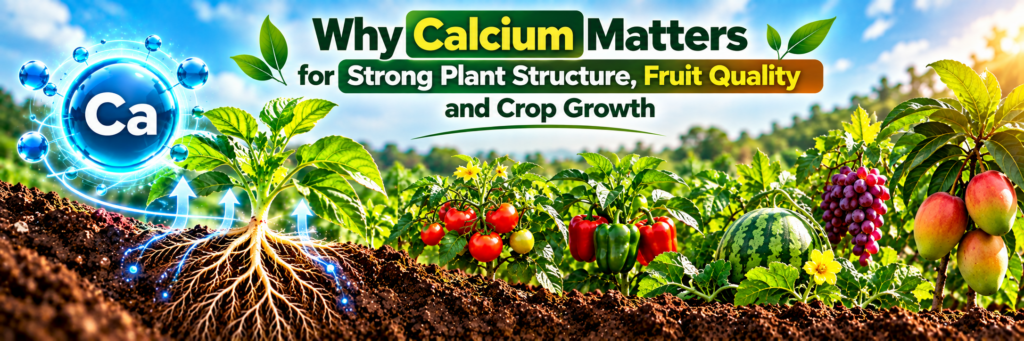
When we think about crop nutrition, we often focus on nitrogen, phosphorus and potassium. However, calcium also has an important role in building healthy plants and supporting crop development. It contributes to plant cell structure, root and shoot development, and the overall strength of growing tissues.
For horticultural crops, calcium management becomes particularly important because plant structure, fruit development and fruit quality are closely linked to balanced nutrition. We therefore see calcium as an important part of a complete crop nutrition programme rather than a nutrient that should only be considered when a deficiency appears.
We offers calcium-based products within its Water-Soluble Fertiliser and Liquid Fertiliser portfolios, including Calcium Nitrate with Magnesium and Concentrated Liquid Calcium – 11%. These products can be integrated into crop nutrition programmes according to crop requirements and recommended application practices.
What Does Calcium Do in Plants?
When we look at the role of calcium, one of its main functions is supporting the structure of plant cells. Calcium contributes to the strength and stability of cell walls, helping growing tissues maintain their structure.
Calcium is also important for normal root and shoot development. Since it is not easily moved from older tissues to new growth, a continuous supply is important, particularly when plants are actively developing new leaves, shoots, flowers and fruits.
This makes calcium management relevant throughout several stages of the crop cycle.
1. Supporting Strong Plant Structure
We begin with the plant itself. Healthy stems, leaves and growing tissues depend on balanced nutrition.
Calcium contributes to cell-wall formation and helps maintain the structural integrity of plant tissues. Adequate calcium availability can therefore support healthy plant growth and stronger developing tissues.
For crops undergoing rapid vegetative growth, maintaining an appropriate calcium supply can complement the wider nutrient programme and help support continued development.
2. Supporting Healthy Root and Shoot Growth
We also need to consider the root system because strong roots are essential for water and nutrient uptake.
Calcium is involved in cell division and the development of growing tissues. This makes it relevant during periods when roots, shoots and new plant growth are developing actively.
A balanced nutrition programme that includes calcium, alongside appropriate primary and secondary nutrients, can therefore support the crop from establishment through vegetative growth.
3. Supporting Fruit Development
When we move from vegetative growth to fruit development, nutrient management becomes even more important.
Developing fruits are made up of rapidly growing tissues, and calcium contributes to cell-wall structure. Maintaining adequate calcium availability can therefore support normal fruit development as part of an overall balanced nutrition programme.
For horticultural crops, this is particularly relevant during flowering, fruit set and fruit enlargement, when nutrient demand can change quickly.
Our Calcium Nitrate with Magnesium provides calcium together with nitrogen and magnesium, while Concentrated Liquid Calcium – 11% is a liquid fertiliser that offers another calcium source. These products can be considered where the crop requires additional calcium as part of its nutritional programme.
4. Supporting Fruit Quality
We know that good fruit quality depends on several factors, including genetics, irrigation, crop health, temperature and nutrient management.
Calcium contributes to the structure of plant tissues and can therefore play an important role in maintaining the quality of developing fruits. Balanced calcium nutrition is especially relevant where crops are producing rapidly growing fruits and require a steady supply of nutrients.
However, we should not view calcium as a standalone solution for every fruit-quality issue. Soil conditions, irrigation, crop load and the availability of other nutrients also need to be considered.
5. Integrating Calcium into Crop Nutrition
We believe calcium works best when it is integrated into a complete nutrient-management programme.
A practical approach can include:
- Before planting: Assess soil fertility and identify nutrient requirements where possible.
- During vegetative growth: Maintain balanced nutrition to support root, shoot and leaf development.
- At flowering and fruit set: Pay attention to calcium availability as reproductive growth begins.
- During fruit development: Maintain appropriate nutrient and water management as fruits enlarge.
- Throughout the season: Follow crop-specific recommendations, product directions and suitable application methods.
This stage-based approach helps us provide nutrients according to the changing needs of the crop rather than applying the same programme throughout the season.
6. Calcium Works Within a Balanced Programme
We should also remember that calcium does not work in isolation. Plants require a combination of primary, secondary and micronutrients to complete different physiological functions.
Our wider portfolio includes chemical fertilisers, water-soluble fertilisers, liquid nutrients, biofertilisers and micronutrients. Calcium-based products can therefore be integrated with other nutrient sources depending on the crop and growing conditions.
For example, a horticultural crop may require calcium alongside nitrogen, phosphorus, potassium, magnesium and micronutrients during different stages of its development. Soil testing and crop-specific guidance can help determine the appropriate programme.
Building Stronger Crops from the Inside
For us, calcium is an important part of the foundation of healthy crop growth. From supporting cell structure and new plant growth to contributing to fruit development and quality, calcium has a role throughout the crop cycle.
Our Calcium Nitrate with Magnesium and Concentrated Liquid Calcium – 11% provide calcium sources that can be incorporated into suitable crop nutrition programmes. Concentrated Liquid Calcium – 11% is a liquid fertiliser.
Our objective should not simply be to apply more nutrients, but to understand what the crop needs, when it needs it and how different nutrients work together. With balanced nutrition, appropriate irrigation, soil assessment and crop-stage management, we can support stronger plants, healthier fruit development and more consistent crop performance.