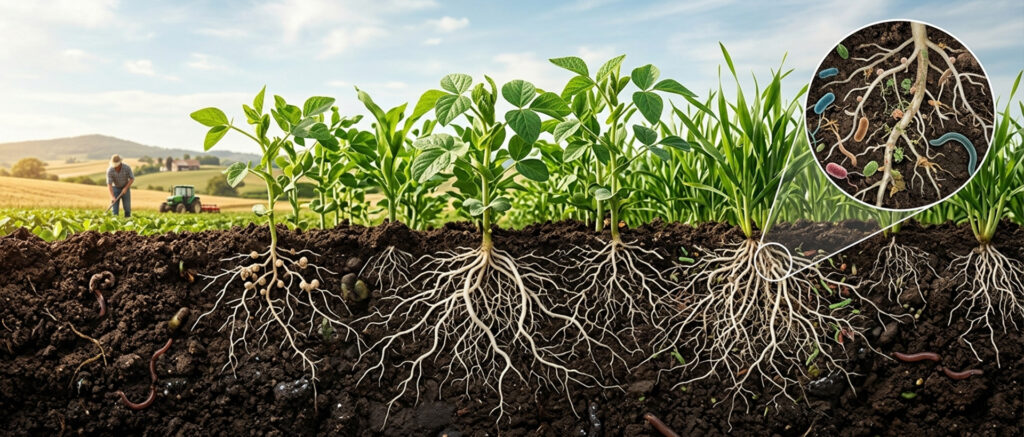
Modern agriculture faces many challenges. Farmers are expected to produce higher yields while maintaining soil health and reducing production costs. Over the years, intensive farming practices and excessive dependence on chemical inputs have affected soil fertility, microbial activity, and overall soil productivity. As a result, many farmers are looking for sustainable solutions that improve crop performance without harming the environment.
One of the most effective ways to achieve this balance is through the use of biofertilisers. These natural agricultural inputs help strengthen root development, improve soil biology, and enhance nutrient availability. Healthy roots and active soil microorganisms work together to support stronger crops, higher yields, and long-term soil productivity.
Today, biofertiliser solutions offered by Narmada Bio-chem Limited (NBCL) are helping farmers across India improve soil health and achieve better crop performance through sustainable farming practices.
Understanding the Importance of Healthy Roots
Roots are often called the foundation of a plant. While leaves, flowers, and fruits are visible above the ground, the roots perform some of the most important functions below the soil surface.
Healthy roots help plants:
- Absorb water efficiently
- Take up essential nutrients
- Anchor the plant firmly in the soil
- Support growth and development
- Withstand environmental stress
When root systems are weak, plants struggle to absorb nutrients and water, leading to poor growth and lower yields.
Strong root development is therefore essential for achieving healthy crops and maximum productivity.
What Is Soil Biology?
Soil is much more than a medium that holds plants in place. It is a living ecosystem filled with beneficial microorganisms.
These include:
- Bacteria
- Fungi
- Actinomycetes
- Algae
- Protozoa
Together, these microorganisms form the soil biology that supports plant growth.
Healthy soil biology helps:
- Break down organic matter
- Release nutrients into plant-available forms
- Improve soil structure
- Enhance water retention
- Protect plants from harmful pathogens
When soil biology is active and balanced, crops can grow more efficiently and utilise nutrients more effectively.
What Are Biofertilisers?
Biofertilisers are natural products that contain beneficial microorganisms that improve nutrient availability and promote plant growth.
Unlike chemical fertilisers that directly supply nutrients, biofertilisers enhance natural biological processes within the soil, helping plants access nutrients more efficiently while improving soil health.
Common types of biofertilisers include:
- Nitrogen-fixing bacteria such as NBCL Azotobacter and NBCL Azospirillum
- Phosphate-solubilising bacteria such as NBCL PSB
- Potash-mobilising bacteria
- Plant Growth-Promoting Rhizobacteria (PGPR)
- Mycorrhizal fungi such as NBCL Muladhar Mycorrhizal based Biofertilizer
These beneficial organisms work in partnership with plant roots to improve nutrient uptake, root development, and soil fertility.
How Biofertilisers Support Root Development
Improved Root Growth
Biofertilisers stimulate root growth by producing natural plant growth-promoting substances.
As a result, plants develop:
- Longer roots
- More root branches
- Greater root surface area
A larger root system enables plants to explore a greater volume of soil and absorb more nutrients and water.
Products such as NBCL Mycorrhiza help promote root proliferation, improve root architecture, and enhance microbial activity around the root zone. This leads to stronger crop establishment and improved growth throughout the crop cycle.
Better Nutrient Absorption
Many nutrients in the soil remain unavailable to plants because they exist in insoluble forms.
Beneficial microorganisms help convert these nutrients into forms that plants can absorb easily.
This improves the availability of:
- Nitrogen
- Phosphorus
- Potassium
- Micronutrients
For example, NBCL PSB helps solubilise fixed phosphorus in the soil, while NBCL Azotobacter and NBCL Azospirillum contribute to biological nitrogen fixation, improving nutrient availability and supporting healthy plant growth.
Enhanced Water Utilisation
Well-developed roots can access water from deeper soil layers.
This helps plants:
- Tolerate dry conditions more effectively
- Reduce moisture stress
- Maintain growth during challenging weather conditions
Improved water-use efficiency is becoming increasingly important as climate conditions become more unpredictable.
How Biofertilisers Improve Soil Biology
Increased Microbial Activity
Biofertilisers introduce beneficial microorganisms into the soil and support the growth of existing microbial populations.
Products such as NBCL Mycorrhiza help establish a healthy microbial ecosystem that enhances nutrient cycling and improves overall soil fertility.
Improved Organic Matter Breakdown
Microorganisms help decompose crop residues and organic matter.
This process releases nutrients back into the soil and improves soil structure.
As organic matter breaks down, the soil becomes richer, more fertile, and more productive.
Better Soil Structure
Healthy microbial activity helps create stable soil aggregates.
Improved soil structure provides:
- Better aeration
- Enhanced drainage
- Improved root penetration
- Increased water retention
These conditions create an ideal environment for healthy crop growth.
Suppression of Harmful Microorganisms
Beneficial microbes compete with harmful pathogens for space and resources.
This natural biological activity helps reduce disease pressure and supports healthier crops without excessive dependence on chemical inputs.
Benefits of Biofertiliser Solutions for Farmers
- Higher Crop Productivity: Improved nutrient availability and stronger root systems support better plant growth and higher yields.
- Reduced Fertiliser Costs: Biofertilisers improve nutrient-use efficiency, allowing crops to utilise available nutrients more effectively.
- Improved Soil Fertility: Regular use of biofertilisers contributes to long-term soil health by supporting biological activity and nutrient cycling.
- Sustainable Farming Practices: Biofertilisers are environmentally friendly and help reduce the negative impact of excessive chemical input use.
They support sustainable agriculture while maintaining crop productivity.
How Narmada Bio-chem Limited Helps Farmers
Narmada Bio-chem Limited is committed to helping farmers improve productivity through innovative and sustainable agricultural solutions.
Biofertiliser Solutions
NBCL offers a range of advanced biofertiliser products designed to strengthen root development, improve nutrient availability, and enhance soil biology.
Key products include:
- NBCL Mycorrhiza – Supports extensive root development and improves nutrient and water uptake.
- NBCL PSB – Improves phosphorus availability for better root and shoot development.
- NBCL Azotobacter – Helps increase nitrogen availability through biological fixation.
- NBCL Azospirillum – Supports root growth and nutrient uptake while improving overall crop vigour.
These solutions help farmers improve nutrient efficiency, strengthen root systems, and achieve healthier crop growth.
Bio-Liquid Fertilisers
NBCL’s bio-liquid fertiliser range supports nutrient efficiency and crop performance throughout different stages of plant growth.
These formulations help:
- Improve nutrient uptake
- Enhance plant vigour
- Promote root development
- Support higher crop productivity
When integrated with balanced nutrient management programmes, bio-liquid fertilisers help maximise crop performance and resource-use efficiency.
Soil Conditioning Products
Healthy soil is the foundation of successful farming.
NBCL’s soil conditioning solutions help:
- Improve soil structure
- Increase water retention
- Enhance microbial activity
- Support deeper root penetration
These improvements create a favourable environment for sustainable crop production.
Integrated Crop Nutrition Support
The company promotes balanced nutrient management practices that combine biological solutions with modern farming techniques.
This integrated approach helps farmers achieve better yields while maintaining long-term soil fertility and environmental sustainability.
Best Practices for Using Biofertilisers
To achieve maximum benefits from biofertilisers, farmers should follow certain guidelines.
- Use Quality Products
Always select reliable and scientifically developed biofertiliser products from trusted manufacturers.
- Apply at the Right Time
Early application allows beneficial microorganisms to establish themselves in the root zone and support plant development from the beginning.
- Maintain Good Soil Conditions
Adequate moisture and organic matter help beneficial microbes survive and multiply.
- Combine with Balanced Nutrition
Biofertilisers work best when used alongside proper fertiliser management and good agronomic practices.
The Future of Sustainable Agriculture
As farmers face increasing pressure to improve productivity while preserving natural resources, biofertilisers are becoming an important part of modern agriculture.
Their ability to strengthen root systems, improve soil biology, and support sustainable farming makes them a valuable tool for long-term agricultural success.
By integrating biological solutions with balanced nutrient management, farmers can improve crop performance while protecting soil health for future generations.
Conclusion
Strong roots and healthy soil biology are essential for achieving sustainable crop productivity. Biofertilisers help create a thriving soil ecosystem where plants can access nutrients more efficiently, develop stronger root systems, and grow more vigorously.
Through advanced solutions such as NBCL Mycorrhiza, NBCL PSB, NBCL Azotobacter, and NBCL Azospirillum, along with bio-liquid fertilisers and soil conditioning products, Narmada Bio-chem Limited helps farmers improve soil health, enhance nutrient availability, and support stronger crop growth.
By adopting these sustainable solutions, farmers can build healthier soils, achieve higher yields, and create a more productive future for agriculture.