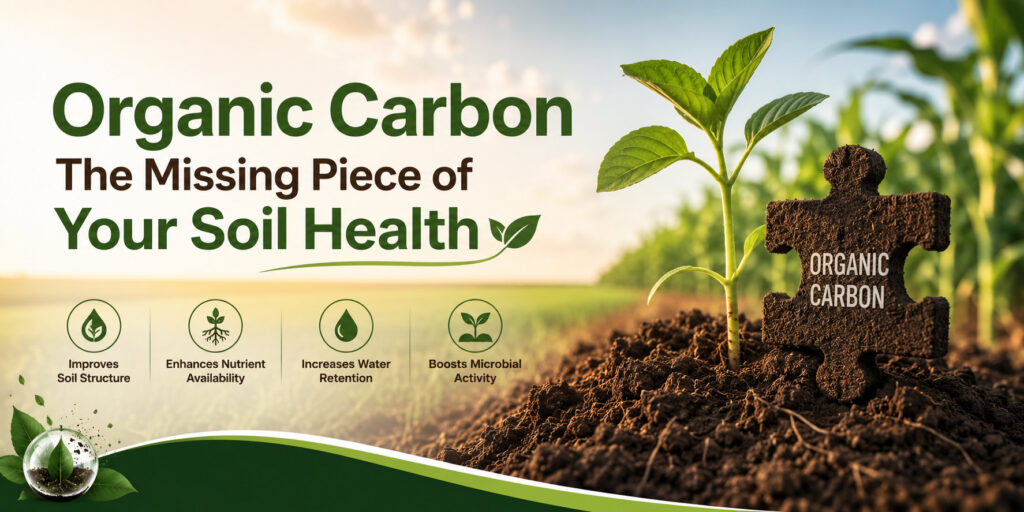
Healthy soil is the foundation of successful agriculture. While farmers often focus on applying nitrogen, phosphorus, and potassium (NPK) fertilisers to improve crop yields, one critical component is frequently overlooked organic carbon. Often referred to as the “engine of soil fertility,” organic carbon plays a vital role in maintaining soil structure, supporting microbial life, improving nutrient availability, and enhancing crop productivity.
Across India, intensive cultivation, excessive use of chemical fertilisers, residue burning, and inadequate addition of organic matter have led to a steady decline in soil organic carbon levels. As a result, many agricultural soils are becoming less fertile, less productive, and increasingly vulnerable to drought and nutrient deficiencies.
Restoring soil organic carbon is no longer just an option it is essential for sustainable agriculture. Through the use of organic soil amendments and scientifically developed products from Narmada Bio-Chem Limited (NBCL), farmers can rebuild soil health, improve nutrient-use efficiency, and unlock the full productivity of their land.
What is Organic Carbon
Organic carbon is the carbon component of organic matter present in the soil. It originates from decomposed crop residues, farmyard manure, compost, green manure, plant roots, and beneficial microorganisms.
Although organic carbon usually represents only a small percentage of the soil, it has a profound influence on almost every aspect of soil health. It serves as the primary energy source for beneficial soil microorganisms and helps maintain a balanced, biologically active, and productive soil ecosystem.
Healthy soils rich in organic carbon are structurally stable, biologically active, and capable of supplying nutrients efficiently throughout the crop cycle.
Why Organic Carbon is Important
Organic carbon performs several essential functions that directly influence crop growth and productivity.
1. Improves Soil Structure
Organic carbon binds soil particles together, creating stable aggregates that improve soil structure.
Good soil structure promotes:
-
- Better root penetration
- Improved aeration
- Enhanced drainage
- Reduced soil compaction
- Easier seed germination
Well-structured soil allows roots to explore a larger soil volume, enabling crops to absorb more nutrients and water.
2. Enhances Water-Holding Capacity
One of the greatest advantages of organic carbon is its ability to improve the soil’s moisture-retention capacity.
Soils with higher organic carbon can store more water and release it gradually during dry periods. This reduces drought stress, improves irrigation efficiency, and supports healthy crop growth under variable weather conditions.
3. Supports Beneficial Soil Microorganisms
Soil is a living ecosystem containing millions of beneficial microorganisms, including:
-
- Nitrogen-fixing bacteria
- Phosphate-solubilising bacteria
- Mycorrhizal fungi
- Potassium-mobilising bacteria
- Plant Growth-Promoting Rhizobacteria (PGPR)
Organic carbon provides these microorganisms with the energy they require to grow, multiply, and perform essential biological functions.
An active microbial population improves nutrient cycling, organic matter decomposition, and overall soil fertility.
The Relationship Between Organic Carbon and Plant Nutrition
Healthy soils gradually supply nutrients throughout the crop cycle.
Organic carbon improves nutrient availability by:
-
- Increasing cation exchange capacity (CEC)
- Reducing nutrient leaching
- Improving nutrient retention
- Supporting biological nutrient transformation
- Enhancing fertiliser-use efficiency
As a result, crops utilise applied fertilisers more effectively, reducing wastage while improving productivity.
NBCL Solutions for Improving Soil Organic Carbon
Maintaining adequate soil organic carbon requires the continuous addition of organic matter. NBCL offers scientifically formulated products that enrich soil organic carbon while improving overall soil fertility.
1. NBCL Bio Gold
NBCL Bio Gold is an organic manure enriched with beneficial microorganisms and organic matter that helps improve soil fertility naturally. Regular application enhances soil organic carbon, stimulates microbial activity, and improves soil structure, creating favourable conditions for healthy crop growth.
Key benefits include:
-
- Increases soil organic carbon
- Improves soil structure and aggregation
- Enhances microbial activity
- Improves nutrient availability
- Increases water-holding capacity
- Promotes healthier crop growth
2. NBCL PROM / Powerphos
NBCL PROM (Phosphate Rich Organic Manure) / Powerphos combines the benefits of organic manure with phosphorus nutrition. Besides supplying phosphorus, it enriches the soil with valuable organic matter that improves soil health and supports long-term fertility.
Its regular use helps:
-
- Increase soil organic carbon
- Improve phosphorus availability
- Enhance microbial activity
- Improve soil fertility
- Support sustainable crop production
By incorporating products such as Bio Gold and PROM/Powerphos into nutrient management programmes, farmers can steadily rebuild soil organic matter while improving crop productivity.
Building Strong Root Systems
Healthy roots are the foundation of productive agriculture.
Organic carbon creates favourable soil conditions that encourage extensive root development by improving soil porosity, aeration, and moisture availability.
This process can be further enhanced with NBCL Mycorrhiza, which forms a beneficial association with plant roots. The fungal network extends beyond the natural root zone, enabling crops to absorb more phosphorus, water, and micronutrients.
Similarly, NBCL Muladhar supports healthy root-zone biology, creating an ideal environment for root proliferation and efficient nutrient uptake.
Together, organic carbon, Mycorrhiza, and Muladhar establish a strong foundation for healthy plant growth.
Improving Soil Biology for Long-Term Productivity
Healthy soils are biologically active soils.
Increasing soil organic carbon encourages beneficial microorganisms that:
-
- Decompose crop residues
- Release nutrients naturally
- Improve soil aggregation
- Enhance water infiltration
- Suppress harmful pathogens
Regular application of organic carbon-rich products helps restore soil biodiversity while improving long-term soil productivity.
Balanced Nutrition with BIO NPK
Healthy soils require more than individual nutrients.
NBCL BIO NPK contains beneficial microbial consortia that improve the natural availability of nitrogen, phosphorus, and potassium within the soil.
When combined with improved organic carbon levels, BIO NPK enhances nutrient cycling and supports balanced crop nutrition throughout the growing season.
This integrated approach improves:
-
- Crop establishment
- Nutrient-use efficiency
- Plant vigour
- Crop quality
- Yield potential
How Farmers Can Increase Organic Carbon
Improving soil organic carbon requires consistent soil management practices.
Farmers should consider:
-
- Incorporating crop residues after harvest
- Applying well-decomposed farmyard manure or compost
- Using green manure crops
- Reducing residue burning
- Adopting crop rotations
- Minimising excessive tillage
- Applying Bio Gold and PROM/Powerphos regularly
- Maintaining balanced fertiliser programmes
Combining these practices helps create healthier soils capable of sustaining high crop productivity year after year.
Economic Benefits of Healthy Soil
Improving soil organic carbon is an investment rather than an expense.
Healthy soils help farmers achieve:
-
- Better nutrient-use efficiency
- Reduced fertiliser losses
- Improved water retention
- Stronger root systems
- Better crop resilience
- Higher yields
- Improved produce quality
- Lower production costs
- Long-term soil sustainability
As soil health improves, farmers experience more consistent crop performance and greater profitability.
Why Soil Health is the Future of Agriculture
Modern agriculture is shifting from simply feeding crops to feeding the soil.
Healthy soils rich in organic carbon are better equipped to support beneficial microorganisms, improve nutrient availability, and withstand environmental challenges.
NBCL’s soil health solutions, including Bio Gold, PROM/Powerphos, Muladhar, Mycorrhiza, and BIO NPK, help farmers improve soil organic matter, strengthen soil biology, and enhance nutrient-use efficiency for sustainable crop production.
By integrating these solutions with good organic matter management practices, farmers can restore soil vitality and create resilient farming systems that remain productive for generations.
Conclusion
Organic carbon is rightly described as the missing piece of soil health because it influences nearly every aspect of crop production. It improves soil structure, enhances water retention, supports beneficial microorganisms, and increases nutrient-use efficiency, all of which contribute to healthier crops and higher yields.
NBCL’s organic soil management solutions, including Bio Gold, PROM/Powerphos, Muladhar, Mycorrhiza, and BIO NPK, help farmers build living, productive soils capable of sustaining profitable agriculture.
Investing in soil organic carbon is not simply about improving the next harvest it is about protecting the long-term productivity, resilience, and sustainability of agricultural land. Healthy soils are the foundation of healthy crops, and organic carbon is the key to unlocking their full potential.