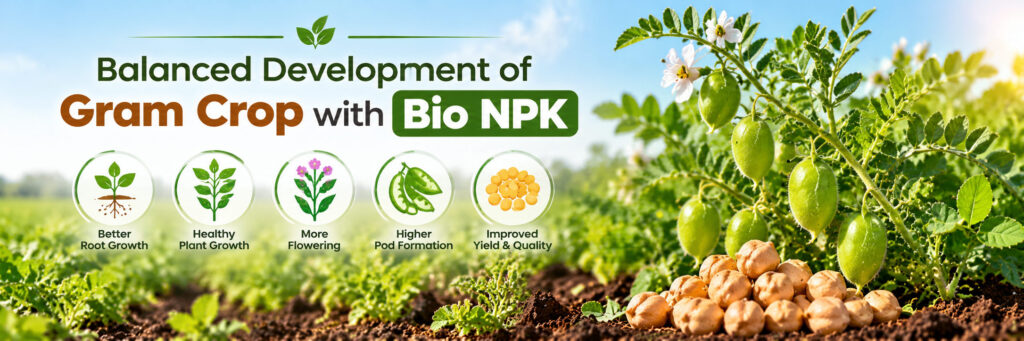
A healthy gram crop begins with a strong foundation beneath the soil. The seeds germinate, roots begin to develop, beneficial microorganisms interact with the plant, and essential nutrients support the crop through its different growth stages. From early vegetative growth to flowering and pod formation, each stage contributes to the quality and quantity of the final harvest.
Gram, commonly known as chickpea, is an important pulse crop in India. It is valued for its protein-rich seeds and its role in agricultural systems. As a legume, gram has a unique relationship with beneficial soil bacteria that can help supply nitrogen to the plant. However, healthy crop development still depends on the availability of phosphorus, potassium and other essential nutrients.
This is where Bio NPK can play a role in an integrated crop nutrition programme. By introducing beneficial microorganisms that support nutrient availability and cycling, suitable Bio NPK formulations can complement conventional fertilisers and help farmers manage crop nutrition more effectively. The objective is to encourage balanced plant development while making better use of the nutrients available in the soil.
Why Balanced Nutrition Matters in Gram Cultivation
Gram requires an appropriate supply of nutrients throughout its growing cycle. During early growth, the crop develops its roots and branches. As it matures, flowering and pod formation become increasingly important for determining the final seed yield.
An imbalance in nutrient availability can affect these processes. While nitrogen is essential for plant growth, excessive reliance on nitrogen fertilisers may interfere with biological nitrogen fixation under certain conditions. Phosphorus supports root development, energy transfer and nodulation, while potassium contributes to water regulation and several metabolic processes.
Bio NPK products may help support nutrient management through beneficial microorganisms, depending on their formulation and the functions of the microbial strains they contain.
1. Understanding Bio NPK and Its Role in Gram
Bio NPK refers to biofertiliser formulations containing beneficial microorganisms associated with nitrogen, phosphorus and potassium nutrition. Unlike conventional NPK fertilisers, which supply nutrients directly in mineral forms, microbial Bio NPK products work through biological processes that can help improve nutrient availability.
Different microorganisms perform different functions. Nitrogen-fixing bacteria can convert atmospheric nitrogen into forms that plants can use. Phosphate-solubilising microorganisms can help make certain forms of soil phosphorus more available, while potassium-solubilising microorganisms may release potassium from specific soil minerals.
The effectiveness of a Bio NPK product depends on the microbial strains used, soil conditions, moisture, temperature and the availability of nutrients in the growing environment.
For gram cultivation, Bio NPK should therefore be viewed as a complement to balanced fertilisation rather than a complete replacement for conventional fertilisers or crop-specific Rhizobium inoculation.
2. Nitrogen: Supporting Healthy Vegetative Growth
Nitrogen is essential for the formation of proteins, enzymes and chlorophyll, which supports photosynthesis. Healthy nitrogen nutrition helps gram plants develop leaves and branches that contribute to the crop’s overall growth.
However, gram has an important advantage over many other crops: it can form root nodules in association with compatible Rhizobium bacteria. These nodules provide an environment where atmospheric nitrogen can be biologically fixed and made available to the plant.
Certain Bio NPK formulations may contain nitrogen-fixing microorganisms, but not all nitrogen-fixing organisms form effective nodules on gram. For this reason, selecting a compatible Rhizobium inoculant is an important consideration.
Effective biological nitrogen fixation depends on several factors, including suitable soil conditions, adequate phosphorus availability and the presence of compatible bacteria.
When these requirements are met, biological nitrogen fixation can contribute to the crop’s nitrogen supply. Farmers should still follow local nutrient recommendations, as the crop’s nitrogen requirements depend on soil fertility, growing conditions and the effectiveness of nodulation.
3. Phosphorus: Encouraging Root Growth and Nodulation
Phosphorus plays an important role in early plant development and energy transfer. It supports root growth and contributes to the formation and functioning of root nodules, which are essential for biological nitrogen fixation in gram.
However, phosphorus present in the soil is not always readily available for plant uptake. Certain soil conditions can limit its availability, even when the soil contains phosphorus reserves.
Phosphate-solubilising microorganisms in suitable Bio NPK formulations can help mobilise some of this less-available phosphorus through biological processes. This may improve phosphorus availability around the root zone when the relevant conditions are favourable.
Better access to phosphorus can support root development and nodulation, helping the plant establish itself and utilise available nutrients.
Nevertheless, microbial activity cannot eliminate the need for phosphorus fertilisation where soil tests indicate a deficiency. The most effective approach combines suitable microbial inputs with the recommended phosphorus supply.
4. Potassium: Supporting Plant Function and Water Regulation
While nitrogen and phosphorus receive considerable attention in gram cultivation, potassium is also essential for balanced crop development.
Potassium helps regulate water movement within plant cells, activates enzymes and supports several processes involved in photosynthesis and carbohydrate metabolism. Adequate potassium nutrition also contributes to the plant’s ability to maintain normal physiological functions under changing environmental conditions.
Certain potassium-solubilising microorganisms can help release potassium from specific soil minerals. Their contribution depends on the microbial strain and the mineral composition of the soil.
Where potassium availability is limiting, suitable microbial inputs may complement a potassium fertiliser programme. However, Bio NPK should not be assumed to supply the entire potassium requirement of the crop.
Maintaining balanced potassium nutrition, along with appropriate irrigation and other agronomic practices, can support healthy plant development and the formation of well-filled pods.
5. Supporting Flowering, Pod Formation and Seed Development
The ultimate objective of gram cultivation is a healthy harvest with good seed development. Flowering and pod formation are particularly important stages because they influence the number of pods produced and the seeds that develop within them.
Bio NPK may contribute to these stages indirectly by supporting nutrient availability and plant growth. Adequate nitrogen supports plant development, phosphorus contributes to energy transfer and reproductive processes, and potassium helps maintain essential physiological functions.
Research on chickpea has examined the combined use of biofertilisers such as Rhizobium and phosphate-solubilising bacteria alongside phosphorus fertilisation. Some studies have reported improvements in nutrient uptake, nodulation and grain yield under the conditions tested.
However, these results do not mean that every Bio NPK product will produce the same outcome. Yield depends on several interacting factors, including crop variety, soil fertility, rainfall, irrigation, planting practices and pest and disease management.
A balanced nutrient programme helps create favourable conditions for crop development, but no single fertiliser input can guarantee a particular yield.
6. Integrating Bio NPK into a Gram Nutrition Programme
Bio NPK is most useful when incorporated into a planned nutrient management strategy rather than applied without considering the crop’s requirements.
Farmers can follow these general practices:
- Before sowing: Test the soil to assess nutrient availability, pH and other factors affecting crop establishment.
- At planting: Select a suitable Bio NPK product and follow its label instructions for seed treatment, soil application or another recommended method.
- Use compatible Rhizobium: Where appropriate, inoculate gram seed with a strain specifically recommended for chickpea to support effective nodulation.
- Maintain balanced fertilisation: Apply phosphorus, potassium and other nutrients according to soil-test results and local agricultural recommendations.
- Monitor crop growth: Observe root nodulation, vegetative development, flowering and pod formation to identify potential nutrient or management issues.
- Follow product guidance: Check storage conditions, expiry dates and compatibility with seed treatments or other agricultural inputs.
It is important to remember that the effectiveness of microbial products depends on the survival and activity of their beneficial organisms. Farmers should avoid combining products without checking compatibility and should seek guidance from qualified agricultural professionals when necessary.
Building a Balanced Approach to Gram Cultivation
For farmers, successful crop development depends on more than supplying individual nutrients. It requires an understanding of how soil conditions, beneficial microorganisms and balanced fertilisation work together to support healthy growth, flowering and pod formation.
Bio NPK offers an approach to supporting nutrient availability through biological processes. When a suitable formulation is used alongside compatible Rhizobium inoculation, appropriate fertiliser application and sound crop management, it can contribute to a more integrated approach to crop nutrition.
At NBCL, we understand that effective crop nutrition begins with choosing the right inputs for the crop’s specific requirements. With a portfolio spanning biofertilisers, organic fertilisers and chemical fertilisers, NBCL supports a more comprehensive approach to agricultural nutrient management. Our focus on crop nutrition solutions reflects the importance of combining appropriate fertiliser choices with an understanding of soil conditions, nutrient availability and crop development at different growth stages.
By recognising the role of beneficial microorganisms alongside essential plant nutrients, farmers can make more informed decisions about fertiliser application and nutrient management. The aim is to support healthy crop establishment, efficient nutrient utilisation and consistent harvest quality while maintaining a considered approach to soil health.
Ultimately, balanced gram cultivation begins with the right combination of nutrients, beneficial microorganisms and good agronomic practices. At NBCL, we believe that informed nutrient management and suitable agricultural solutions are important steps towards supporting farmers in their pursuit of productive crops and sustainable agricultural practices.