A successful harvest depends on more than the amount of fertiliser applied to the soil. Throughout a crop’s growing cycle, plants must absorb nutrients, regulate water, produce energy and transport the sugars needed for growth and development. When any of these processes is limited by nutrient availability, the crop may struggle to reach its full yield potential.
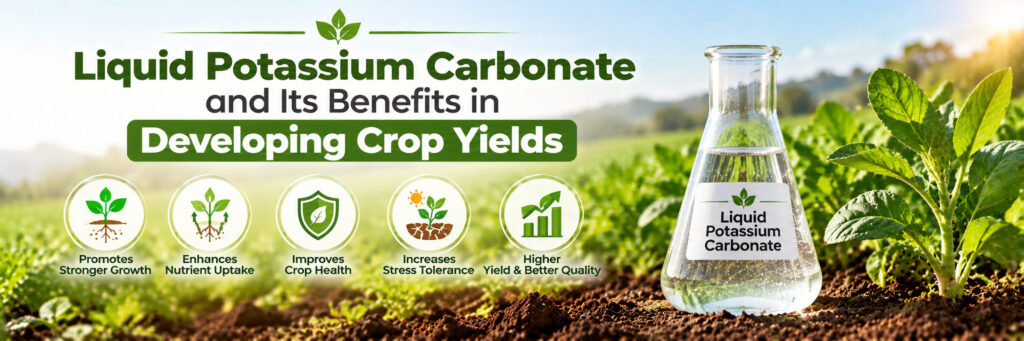
Potassium plays an important role in these processes. As one of the three primary macronutrients required by plants, it supports photosynthesis, water regulation, enzyme activity and the movement of sugars within plant tissues. Liquid potassium carbonate offers a way to supply potassium in a soluble form, making it a useful option in suitable crop nutrition programmes.
For farmers looking to improve crop performance, understanding the role of liquid potassium carbonate can help inform fertiliser choices. When used appropriately, it can complement conventional nutrient management and support healthy plant development, contributing to efforts to improve yield and crop quality.
Why Potassium Matters for Crop Development
Every stage of plant growth depends on an adequate supply of essential nutrients. While nitrogen supports vegetative growth and phosphorus contributes to root development and energy transfer, potassium performs several functions that help plants grow and maintain normal physiological activity.
Potassium is particularly important for regulating the movement of water within plant cells. It also activates enzymes involved in plant metabolism and supports the transport of sugars from leaves to growing tissues, fruits, seeds and other storage organs.
When potassium availability is inadequate, plants may experience reduced growth, weaker stress tolerance and lower productivity. Providing an appropriate potassium supply can therefore help crops maintain essential functions throughout the growing season.
However, potassium fertilisation works best as part of a balanced nutrient management programme. Its benefits depend on the crop’s requirements, existing soil fertility and the availability of other essential nutrients.
1. Supporting Photosynthesis and Energy Production
Healthy leaves are essential for crop development because they capture sunlight and use it to produce sugars through photosynthesis. These sugars provide the energy and carbon compounds needed for growth, flowering, fruit development and seed formation.
Potassium supports several processes associated with photosynthesis, including enzyme activation and the regulation of stomatal opening and closing. Stomata are small openings on leaf surfaces that help regulate gas exchange and water loss.
An adequate potassium supply can help maintain these functions, allowing plants to manage water and support normal photosynthetic activity.
Liquid potassium carbonate supplies potassium in a soluble form. In suitable formulations and application systems, this can provide an additional source of potassium for crops when a supplement is needed.
However, potassium carbonate should not be considered a direct replacement for the other requirements of photosynthesis, such as sunlight, water and carbon dioxide. Its role is to supply potassium, helping address nutritional limitations where they exist.
2. Supporting Water Regulation and Stress Management
Plants continuously balance water uptake through their roots with water loss through their leaves. Potassium contributes to this balance by regulating osmotic pressure within plant cells and influencing stomatal movement.
This function becomes particularly important when crops experience changing environmental conditions, including periods of limited water availability.
Adequate potassium nutrition can help plants regulate water use and maintain cell function under certain stress conditions. It may also support the physiological processes needed for continued growth when environmental conditions are challenging.
Liquid potassium carbonate can contribute to potassium nutrition when used according to the crop’s requirements and the product’s recommended application method.
Nevertheless, it is important to recognise that potassium fertilisation cannot eliminate the effects of severe drought, excessive heat or unsuitable soil conditions. Irrigation management, appropriate planting practices and other agronomic measures remain essential for maintaining crop health.
3. Encouraging the Movement of Sugars and Nutrients
The sugars produced in leaves must reach the parts of the plant where they are needed. These include growing roots, developing fruits, seeds and other storage organs.
Potassium plays an important role in the transport of sugars through the plant’s phloem tissue. This movement supports the development of different plant structures and helps supply energy and carbon compounds to growing tissues.
In fruit crops, adequate potassium nutrition can support fruit development and quality. In grain and oilseed crops, it contributes to the physiological processes associated with seed filling and maturation. In root and tuber crops, potassium supports the movement of carbohydrates towards developing storage organs.
Liquid potassium carbonate can provide an additional source of potassium to support these functions when required. The resulting crop response depends on whether potassium availability is limiting growth and whether the nutrient is applied effectively.
A balanced supply can help crops develop normally, but it does not independently guarantee larger fruits, heavier grains or higher yields.
4. Understanding the Benefits of the Liquid Formulation
Liquid fertilisers offer practical advantages in certain agricultural systems because they can be measured, diluted and applied using suitable spraying or fertigation equipment.
Liquid potassium carbonate contains potassium in a soluble chemical form, although the actual nutrient concentration varies by formulation. Its suitability depends on the crop, application method and intended use.
A liquid formulation may be useful where a farmer needs to supplement potassium through an approved foliar application or an appropriate soil-based application system.
Research published in ACS Agricultural Science & Technology examined the foliar absorption of potassium from different potassium salts in soybean leaves. Potassium carbonate was among the salts that showed relatively high absorption under the experimental conditions. However, nutrient absorption in a particular study does not establish that every formulation or application method will produce the same response across different crops.
The concentration, spray volume, weather conditions and leaf sensitivity all influence application outcomes. Farmers should therefore follow the product label and avoid assuming that a higher concentration will provide better results.
5. Contributing to Crop Yield and Quality
Crop yield is influenced by a combination of genetic potential, nutrient availability, water supply, environmental conditions and crop management.
Potassium contributes to several processes that influence productivity, including photosynthesis, enzyme activity, water regulation and the transport of sugars. When the crop is potassium-deficient, correcting that deficiency can support healthier development and improve the likelihood of achieving its yield potential.
The benefits may vary between crops. For example, potassium is important for grain filling in cereals, seed development in oilseeds, and fruit sizing and quality in horticultural crops.
Research on rice grown in saline soil has also investigated foliar potassium carbonate as a source of potassium and carbon dioxide. The results demonstrated that crop responses depended on factors including the variety, treatment and timing of application. Such findings are useful for understanding potential applications, but they should not be generalised to all crops or growing conditions.
For farmers, the practical objective is to identify whether potassium supplementation is needed and select an appropriate product and application method. Soil testing, crop monitoring and local agronomic recommendations can help guide these decisions.
6. Best Practices for Using Liquid Potassium Carbonate
The effectiveness of any fertiliser depends on more than its nutrient content. Correct application is essential for supporting crop nutrition while avoiding unnecessary damage or nutrient imbalances.
Farmers should consider the following practices:
- Assess crop requirements: Use soil testing, crop history and local recommendations to determine whether additional potassium is needed.
- Select the right application method: Depending on the formulation and label instructions, liquid potassium carbonate may be suitable for specific foliar or soil-based applications.
- Follow the recommended dilution: Potassium carbonate solutions can be strongly alkaline. Applying an unsuitable concentration may damage leaves or affect crop performance.
- Consider weather conditions: For foliar applications, avoid conditions that increase the risk of rapid drying or leaf injury, and follow product-specific guidance on application timing.
- Check compatibility: Do not mix concentrated potassium carbonate with other fertilisers or crop protection products unless compatibility has been confirmed by the manufacturer.
- Maintain balanced nutrition: Potassium should be managed alongside nitrogen, phosphorus, sulphur and micronutrients according to the crop’s needs.
- Monitor crop response: Observe plant health and development after application, and evaluate yield and quality rather than assuming benefits in advance.
These practices help ensure that potassium supplementation forms part of a considered crop management strategy rather than an isolated intervention.
Growing Towards Better Crop Performance
At NBCL, we recognise that effective crop nutrition depends on understanding the relationship between essential nutrients, plant development and growing conditions. Potassium is an important part of this relationship, supporting the physiological processes that allow crops to grow, regulate water and transport the sugars needed for development.
Liquid potassium carbonate can serve as a useful potassium source in suitable agricultural applications. When selected according to crop requirements and applied correctly, it can complement a balanced fertilisation programme and help address potassium-related nutritional limitations.
Ultimately, better crop performance comes from combining appropriate fertiliser solutions with sound agronomic practices, effective water management and an understanding of the crop’s needs at each growth stage. By taking a balanced approach to nutrient management, farmers can work towards healthier crops, improved quality and more productive agricultural systems.