Paddy (rice) is one of the world’s most important staple crops, feeding billions of people and serving as the backbone of food security in many countries, including India. However, rice cultivation today faces numerous challenges such as declining soil fertility, rising cultivation costs, nutrient deficiencies, erratic rainfall, and climate change. These factors often limit crop productivity and reduce farm profitability.
To overcome these challenges, farmers are increasingly adopting biological crop nutrition solutions that improve nutrient availability while enhancing long-term soil health. Among these, mycorrhiza has emerged as one of nature’s most effective tools for promoting healthy root systems and improving nutrient uptake.
Narmada Bio-Chem Limited (NBCL) offers Muladhar, its mycorrhiza-based biological formulation, designed to establish a beneficial association with plant roots, improve nutrient absorption, strengthen root development, and support sustainable paddy cultivation.
Understanding Mycorrhiza
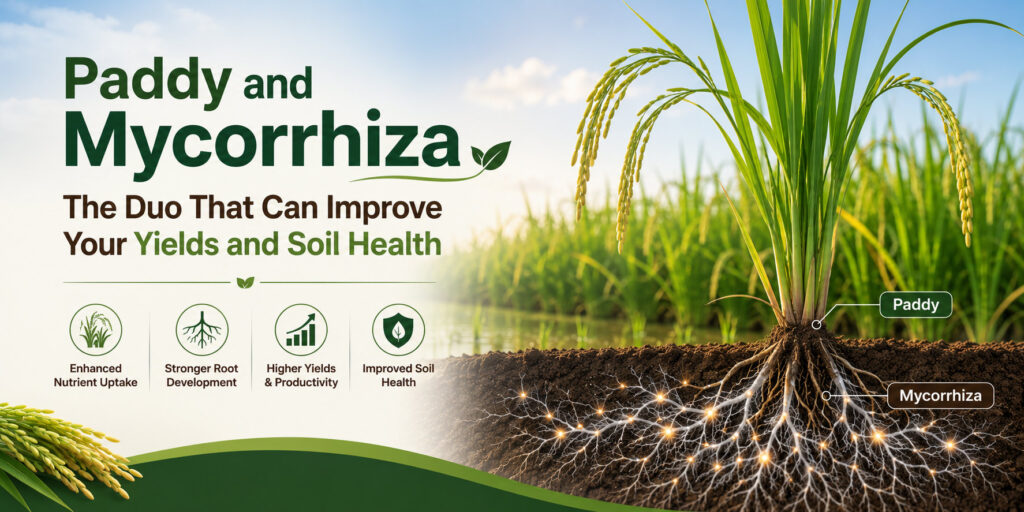
Mycorrhiza refers to naturally occurring beneficial fungi that form a symbiotic relationship with plant roots. Once established, the fungal hyphae spread extensively through the surrounding soil, effectively extending the plant’s root system far beyond its natural reach.
This underground network enables plants to absorb nutrients and water that would otherwise remain inaccessible. In return, the plant supplies carbohydrates to the fungi, creating a mutually beneficial partnership that has evolved over millions of years.
Another remarkable benefit of mycorrhiza is the production of glomalin, a naturally occurring glycoprotein that binds soil particles together. Often referred to as the “soil glue,” glomalin improves soil aggregation, enhances water retention, reduces erosion, and supports carbon sequestration, resulting in healthier and more resilient agricultural soils.
Why Root Health Matters in Paddy
Although paddy is commonly grown under flooded conditions, healthy roots remain the foundation of a productive crop.
A vigorous root system enables rice plants to:
-
- Absorb nutrients more efficiently
- Utilise available water effectively
- Establish stronger seedlings
- Produce more productive tillers
- Support better panicle development
- Improve grain filling and final yield
Weak root development often leads to poor nutrient uptake, reduced tillering, uneven crop growth, and lower productivity.
How Muladhar Improves Paddy Growth
1. Enhanced Root Development
One of the primary benefits of Muladhar is its ability to promote extensive root development.
The mycorrhizal fungal network extends well beyond the natural root zone, increasing the effective surface area available for nutrient absorption.
This leads to:
-
- Stronger root systems
- Better root branching
- Improved nutrient uptake
- Enhanced seedling establishment
- Vigorous crop growth
A healthy root system enables rice plants to perform consistently throughout the growing season.
2. Improved Phosphorus Uptake
Phosphorus plays a vital role in root development, tillering, flowering, and grain formation. However, a large proportion of phosphorus present in agricultural soils becomes chemically fixed and unavailable to crops.
Muladhar improves phosphorus uptake by extending the root absorption zone and accessing phosphorus reserves beyond the reach of ordinary roots.
For even greater phosphorus availability, farmers can integrate NBCL PSB (Phosphate Solubilising Bacteria), which naturally converts insoluble phosphorus into forms readily available to plants.
Together, Muladhar and PSB create an efficient biological system that maximises phosphorus nutrition while improving fertiliser-use efficiency.
Better Water Absorption and Stress Tolerance
Changing weather patterns have made water availability increasingly unpredictable. Even in paddy cultivation, many farmers are shifting towards water-saving practices such as direct-seeded rice and alternate wetting and drying.
The extensive fungal network established by Muladhar improves water absorption from the soil, helping crops tolerate short periods of moisture stress more effectively.
Improved water-use efficiency contributes to healthier crops while supporting sustainable water management practices.
Improved Nutrient-Use Efficiency
Every fertiliser application should deliver maximum benefit to the crop.
Muladhar naturally enhances the uptake of several essential nutrients, including:
-
- Phosphorus
- Zinc
- Copper
- Iron
- Potassium
To further improve nutrient availability, farmers can integrate complementary NBCL biological products:
-
- BIO KMB for potassium mobilisation
- BIO-ZSB (Kranti) for improved zinc availability
- PSB for phosphorus solubilisation
Together, these biological inputs improve nutrient-use efficiency while reducing nutrient losses.
Improving Soil Biology
Healthy soil contains billions of beneficial microorganisms that work together to support plant growth.
Regular use of biological products encourages microbial diversity and stimulates natural soil processes.
By establishing beneficial mycorrhizal colonies around the root zone, Muladhar improves soil biological activity and creates favourable conditions for beneficial microorganisms to flourish.
The result is:
-
- Better nutrient cycling
- Improved soil aggregation
- Enhanced organic matter decomposition
- Greater water-holding capacity
- Long-term soil fertility
Healthy soils provide the foundation for sustainable rice production.
Supporting Balanced Crop Nutrition
While Muladhar significantly improves phosphorus uptake and root health, balanced nutrition requires the availability of all essential nutrients.
NBCL’s biological portfolio complements Muladhar perfectly:
-
- BIO NPK improves the availability of nitrogen, phosphorus, and potassium.
- PSB increases phosphorus availability.
- BIO KMB mobilises soil potassium.
- BIO-ZSB (Kranti) enhances zinc availability.
Integrating these products creates a comprehensive biological nutrition programme that supports:
-
- Uniform crop establishment
- Better tillering
- Stronger stems
- Improved panicle formation
- Higher grain yield
- Better crop quality
Improved Resistance to Environmental Stress
Rice crops are frequently exposed to environmental stresses such as:
-
- Temperature fluctuations
- Nutrient deficiencies
- Moisture stress
- Soil degradation
The stronger root systems developed through Muladhar enable plants to recover more effectively from these stresses.
Improved nutrient uptake and enhanced water absorption help maintain healthy plant growth even under challenging field conditions.
Best Practices for Using Muladhar
To maximise the benefits of Muladhar, farmers should adopt recommended agronomic practices.
These include:
-
- Apply Muladhar during nursery preparation or transplanting to establish beneficial fungal colonies early.
- Integrate NBCL PSB for improved phosphorus availability.
- Apply BIO NPK for balanced microbial nutrition.
- Use BIO KMB where potassium availability is limited.
- Include BIO-ZSB (Kranti) in zinc-deficient soils.
- Maintain adequate soil moisture to support microbial activity.
- Combine biological products with balanced fertiliser programmes and organic matter for optimum crop performance.
Economic Benefits for Farmers
The adoption of Muladhar and complementary biological solutions offers significant economic advantages.
Farmers can benefit from:
-
- Improved fertiliser-use efficiency
- Lower nutrient losses
- Better crop establishment
- Increased tillering
- Improved grain filling
- Higher yields
- Better grain quality
- Improved soil fertility
- Greater long-term profitability
Healthier crops and improved nutrient efficiency help reduce production costs while increasing farm income.
The Future of Sustainable Paddy Cultivation
Modern agriculture is steadily moving towards sustainable and environmentally responsible production systems.
Biological crop nutrition solutions such as Muladhar enable farmers to improve nutrient uptake naturally, strengthen root systems, enhance soil biology, and improve soil structure through glomalin production without placing additional pressure on natural resources.
When integrated with NBCL’s biological portfolio, including BIO NPK, PSB, BIO KMB, and BIO-ZSB (Kranti), Muladhar helps farmers build resilient cropping systems that support both productivity and sustainability.
Conclusion
Healthy roots and healthy soils are fundamental to successful paddy cultivation.
Muladhar, NBCL’s mycorrhiza-based biological formulation, establishes a beneficial partnership with plant roots that improves nutrient uptake, strengthens root development, enhances water-use efficiency, promotes soil aggregation through glomalin production, and supports long-term soil fertility.
When integrated with complementary NBCL biological solutions such as BIO NPK, PSB, BIO KMB, and BIO-ZSB (Kranti), Muladhar provides a comprehensive biological nutrition programme that helps farmers maximise yields, improve fertiliser efficiency, strengthen soil health, and enhance long-term farm profitability.
As agriculture continues to embrace sustainable farming practices, Muladhar offers farmers a scientifically proven solution for producing healthier crops, improving productivity, and preserving one of agriculture’s most valuable resources healthy soil.