Healthy crops begin with healthy roots. Beneath the surface of every productive field, an intricate network of roots, microorganisms and soil organisms works together to support plant growth. While farmers often focus on fertilisers that supply essential nutrients directly, some beneficial microorganisms help plants access nutrients already present in the soil. One such example is mycorrhiza, a naturally occurring association between certain fungi and plant roots.
For Rabi crops, which are cultivated during India’s winter growing season, mycorrhiza can play a useful role in supporting nutrient uptake, root development and soil health. Crops such as wheat, chickpea, mustard and other suitable field crops may benefit from mycorrhizal associations, depending on their compatibility with the fungi and the conditions in which they are grown.
Understanding how mycorrhiza works and how it can be incorporated into crop management helps farmers make more informed decisions about sustainable nutrient management.
Why Rabi Crops Need Effective Nutrient Management
Rabi crops are generally sown during the cooler months and harvested in spring or early summer. Their growth depends on several factors, including soil fertility, moisture availability, temperature, planting time and nutrient management.
Wheat requires a balanced supply of nutrients to support tillering, grain formation and grain filling. Chickpea needs healthy root development and effective nitrogen fixation through its association with compatible Rhizobium bacteria. Mustard requires adequate nutrition for vegetative growth, flowering and seed development.
Although each crop has distinct nutritional requirements, all depend on healthy roots to absorb water and nutrients efficiently. Where nutrients are present in forms that roots cannot readily access, or where soil conditions restrict their availability, crop growth may suffer.
This is where mycorrhiza can contribute. By forming an association with plant roots, these beneficial fungi extend the effective area from which the plant can access certain nutrients and water.
1. What Is Mycorrhiza?
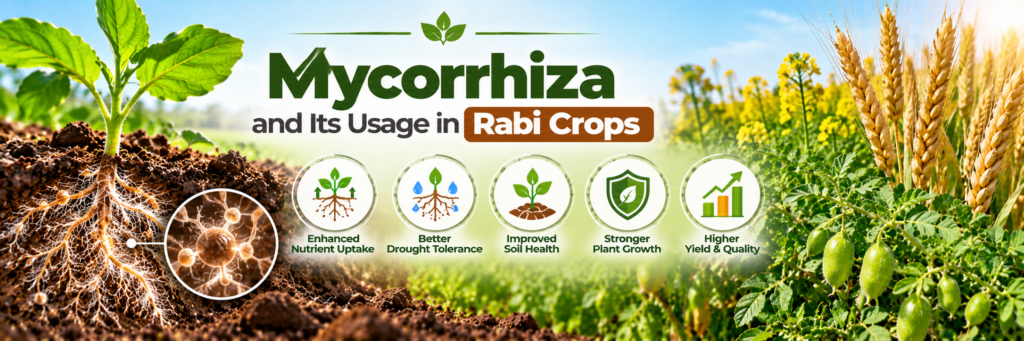
Mycorrhiza refers to a mutually beneficial association between certain fungi and plant roots. The fungi colonise the roots of compatible plants and develop fine, thread-like structures called hyphae that extend into the surrounding soil.
These hyphae can explore soil beyond the immediate root surface, helping the plant access nutrients that may otherwise be difficult to reach. In return, the plant supplies the fungi with carbohydrates produced through photosynthesis.
Arbuscular mycorrhizal fungi, commonly referred to as AMF, are particularly important in agriculture. They can improve the uptake of phosphorus, a nutrient essential for energy transfer, root development and several processes involved in plant growth. Depending on the fungal species and growing conditions, they may also support the acquisition of other nutrients and water.
Mycorrhiza is not a conventional fertiliser that directly supplies a fixed quantity of nutrients. Instead, it is a biological input that can help compatible plants access resources more effectively. Its performance depends on the fungal strain, crop species, soil conditions and overall farm management.
2. How Mycorrhiza Supports Nutrient Uptake
Phosphorus is essential for plant growth, but its availability can be limited because it may become bound to soil minerals or occur in forms that roots cannot readily absorb.
Mycorrhizal fungi extend beyond the root zone through their hyphal networks, increasing the volume of soil explored by the plant. This can improve access to phosphorus and support the plant’s nutritional requirements, particularly where phosphorus availability is limited.
The association may also influence the uptake of certain micronutrients and contribute to water acquisition. However, the extent of these benefits varies with soil fertility, moisture, crop type and the specific mycorrhizal product used.
For Rabi crops, more effective nutrient acquisition can support healthy establishment and continued growth. Nevertheless, mycorrhiza should complement a balanced fertiliser programme rather than automatically replace recommended nutrient applications. Where phosphorus is already abundant or readily available, the additional benefit may be smaller.
3. Usage of Mycorrhiza in Major Rabi Crops
Wheat: Wheat requires sufficient nutrition for root growth, tillering and grain development. Mycorrhizal associations may support phosphorus uptake and help plants access soil resources beyond the immediate root zone. Their contribution depends on the variety, soil conditions and the crop’s existing nutrient supply.
Chickpea: Chickpea is a leguminous crop that forms a nitrogen-fixing association with compatible Rhizobium bacteria. Mycorrhiza performs a different function, primarily supporting the uptake of phosphorus and other soil resources. Since phosphorus is important for root activity and biological nitrogen fixation, the two microbial associations may complement each other when used appropriately.
Mustard: Mustard requires balanced nutrition for vegetative growth, flowering and seed development. Mycorrhiza may improve phosphorus acquisition and support root function under suitable conditions. However, it cannot replace the crop’s requirements for nitrogen, sulphur or other essential nutrients.
Other suitable crops: Some pulses, oilseeds and horticultural crops can also benefit from mycorrhizal associations. Compatibility varies, so farmers should verify that the product is suitable for their specific crop rather than assuming that every formulation works equally well across all Rabi crops.
4. Supporting Soil Health and Crop Resilience
The potential benefits of mycorrhiza extend beyond nutrient uptake. Fungal hyphae interact with soil particles and can contribute to the formation of stable soil aggregates. Better aggregation can support soil structure, porosity and water movement.
Mycorrhizal associations may also help certain crops cope with moderate water stress by improving access to soil moisture. This can be relevant in Rabi cultivation, particularly in areas where irrigation availability is limited or rainfall is uncertain.
However, mycorrhiza does not eliminate the effects of drought, poor soil structure or inadequate irrigation. Its benefits depend on whether the fungi establish successfully and whether the crop’s wider growing conditions support the association.
Maintaining organic matter, avoiding unnecessary soil disturbance and managing irrigation appropriately can help create a more favourable environment for beneficial soil organisms.
5. Best Practices for Applying Mycorrhizal Biofertilisers
The effectiveness of a mycorrhizal product depends not only on its composition but also on how it is stored and applied.
- Choose a suitable product: Select a quality-assured mycorrhizal biofertiliser intended for the crop and application method. Check the label for the fungal species, dosage, storage instructions and expiry date.
- Apply close to the roots: Mycorrhizal fungi need to establish contact with compatible plant roots. Depending on the formulation, application may involve seed or seedling treatment, placement near the root zone or soil application.
- Follow the recommended dosage: Product concentrations and application methods differ. Follow the manufacturer’s instructions or advice from a qualified agricultural expert rather than applying a generic rate across all crops.
- Maintain suitable soil conditions: Adequate moisture and a healthy root environment support fungal establishment. Avoid prolonged waterlogging and other conditions that can damage roots.
- Manage fertiliser inputs carefully: Excessively high levels of readily available phosphorus can reduce the plant’s dependence on mycorrhizal associations. Fertiliser applications should therefore be based on soil testing and crop recommendations.
- Check compatibility: Some chemical treatments and fertiliser mixtures may affect microbial viability. Follow the product label and confirm compatibility before combining mycorrhizal products with other agricultural inputs.
6. Integrating Mycorrhiza into a Balanced Nutrient Management Programme
Mycorrhiza is most useful when treated as one component of an integrated crop nutrition strategy. Organic manures can contribute organic matter and improve soil conditions, while suitable biofertilisers support specific biological processes. Chemical and water-soluble fertilisers can supply nutrients where additional quantities are required.
The right combination depends on the crop, soil test results, previous cropping history and expected yield. For example, chickpea farmers may consider compatible Rhizobium alongside mycorrhiza, while wheat growers may incorporate mycorrhizal products into a broader phosphorus and nitrogen management programme.
The goal is to improve nutrient availability while maintaining a balanced supply for crop growth. Farmers should monitor crop performance and avoid reducing recommended fertiliser doses without appropriate local evidence or agronomic guidance.
Building Healthier Rabi Crops with NBCL
Sustainable crop production depends on understanding the relationship between plants, soil and the microorganisms that support them. Mycorrhiza offers a biological approach to improving nutrient acquisition and supporting soil structure, making it a useful option for suitable Rabi crops when incorporated into an appropriate nutrient management programme.
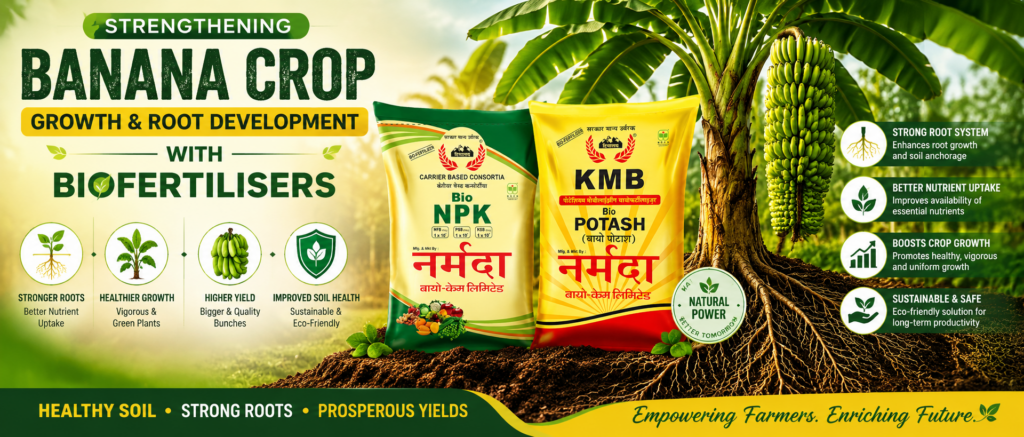
At Narmada Bio-chem Limited (NBCL), the focus is on supporting agriculture through a broad portfolio of organic, bio and chemical fertilisers, alongside water-soluble fertilisers, liquid fertilisers, micronutrients and soil conditioners. NBCL’s biofertiliser range includes products such as BIO NPK, Azotobacter, Azospirillum, phosphate-solubilising bacteria, potassium-mobilising bacteria and Rhizobium. These products serve different nutritional and biological functions and can be selected according to crop requirements. Mycorrhiza should be sourced as a suitable, specifically labelled product where required.
By combining appropriate agricultural inputs with soil testing, sound agronomic practices and responsible fertiliser use, farmers can work towards improved nutrient management and healthier Rabi crops. Ultimately, productive farming is not only about supplying nutrients, but also about creating soil conditions in which crops can make the best use of the resources available to them.