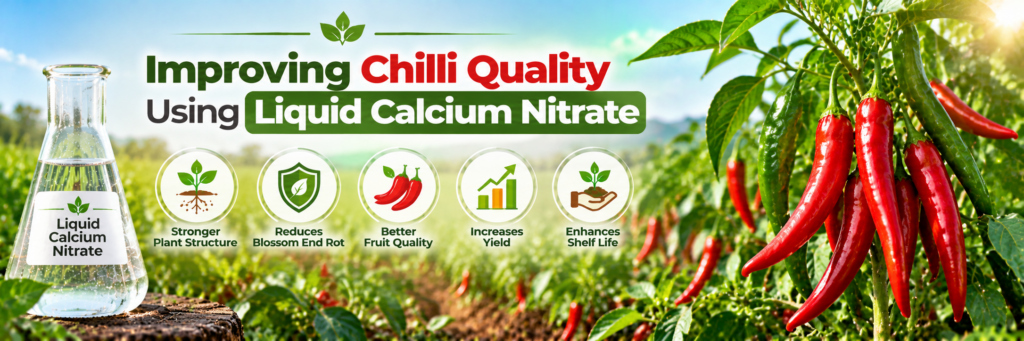
From the bright red colour of dried chillies to the firmness and appearance of fresh green chillies, quality plays an important role in determining their market value. For farmers, producing a healthy chilli crop involves more than achieving a high yield. They must also develop well, mature appropriately and meet the quality expectations of traders, processors and consumers.
Achieving this requires careful attention to crop nutrition throughout the growing season. Among the nutrients involved, calcium and nitrogen play important roles in plant development. Liquid calcium nitrate provides both nutrients in a water-soluble form, making it a useful option within a balanced chilli nutrition programme.
When applied appropriately, calcium nitrate can support plant growth and contribute to improvements in certain chilli quality parameters. Understanding how it works, when it may be useful and how to apply it responsibly helps farmers make more informed decisions about crop nutrition.
Why Calcium and Nitrogen Matter in Chilli Cultivation
Chilli is an important vegetable and spice crop cultivated for fresh consumption, drying, processing and the production of value-added products. Its quality depends on several factors, including variety, growing conditions, nutrient availability, irrigation and harvesting practices.
Calcium and nitrogen contribute to different aspects of crop development.
Calcium supports the formation and stability of plant cell walls and membranes. It is important for growing tissues, root development and the structural integrity of plant cells. Adequate calcium nutrition can help plants maintain healthy tissues, including developing fruits, although the benefits depend on whether calcium is actually limiting and whether it reaches the required plant tissues.
Nitrogen, meanwhile, is essential for chlorophyll formation, protein synthesis and vegetative growth. Healthy leaves enable the plant to carry out photosynthesis and produce the energy needed for flowering and fruit development.
A shortage of either nutrient can restrict plant performance. However, excessive nitrogen can encourage overly vigorous vegetative growth and may interfere with balanced flowering and fruiting. The objective is therefore to supply nutrients according to crop requirements rather than simply increasing their application.
1. Understanding Liquid Calcium Nitrate
Calcium nitrate is a fertiliser that supplies calcium and nitrate nitrogen. Its water-soluble nature allows it to be dissolved for suitable fertigation systems or other applications specified by the product manufacturer.
Unlike fertilisers that supply only one of these nutrients, calcium nitrate provides both in a single formulation. This can be useful when soil testing, plant symptoms or an established crop nutrition programme indicates a need for additional calcium and nitrogen.
Liquid formulations can also offer convenience in handling and application, depending on the product’s concentration and intended use.
For chilli cultivation, its role should be considered alongside the crop’s overall nutritional requirements, including phosphorus, potassium, magnesium and essential micronutrients.
2. Supporting Healthy Plant Growth and Flowering
A productive chilli crop requires healthy roots, well-developed foliage and a balanced transition from vegetative growth to flowering and fruit formation.
Nitrogen supplied through calcium nitrate contributes to leaf growth and chlorophyll production. When nitrogen is deficient, plants may develop pale foliage and weak growth, limiting their ability to support fruit development.
Calcium contributes to the development of growing tissues and helps maintain cell structure. Together, these nutrients can support normal plant development when supplied in appropriate quantities.
However, calcium nitrate should not be viewed as a universal solution for flower drop. Flowering and fruit set are influenced by temperature, humidity, water availability, pollination, plant health and the balance of nutrients in the soil. Excessive nitrogen may also encourage vegetative growth at the expense of reproductive development.
Farmers should therefore assess the crop’s growth stage and overall condition before introducing additional nutrient applications.
3. Improving Chilli Fruit Quality
Fruit quality is particularly important for chilli farmers because it influences how the produce is graded, sold and processed. Depending on the market, important characteristics may include fruit firmness, colour, appearance, size and suitability for drying.
Calcium plays a role in maintaining cell wall structure, which contributes to the integrity of plant tissues. Adequate calcium nutrition can support developing fruits, particularly where calcium availability is insufficient. Nevertheless, the outcome depends on the crop, growing conditions and the way the nutrient is supplied.
This distinction matters because chilli quality is influenced by several interacting factors. Variety selection, maturity at harvest, drying methods and post-harvest handling remain important even when nutrient management is effective.
4. The Role of Calcium Nitrate During Fruit Development
Fruit development is a critical stage in chilli cultivation. During this period, the crop must maintain sufficient nutrient and water supply to support the growth of developing fruits.
Calcium moves primarily through the plant’s water-conducting tissues, meaning its distribution depends partly on water movement and transpiration. As a result, supplying calcium does not automatically ensure that sufficient quantities reach every developing fruit.
Maintaining consistent soil moisture is therefore important. Water stress can affect nutrient uptake and fruit development, while excessive irrigation or waterlogging can damage roots and disrupt normal plant function.
Where a calcium deficiency has been identified or additional calcium is recommended, calcium nitrate may be incorporated into the crop nutrition programme through an appropriate application method. The choice between fertigation and foliar application should depend on the crop’s needs, the formulation and local agronomic guidance.
It is also important to remember that calcium nitrate supplies nitrogen. Its application must be included in the crop’s total nitrogen budget to avoid excessive fertilisation.
5. Best Practices for Applying Liquid Calcium Nitrate
Correct application is essential to achieving the intended benefits while avoiding unnecessary costs or crop injury.
- Follow the recommended dosage: Calcium nitrate products differ in concentration and formulation. Use the rate stated on the product label or recommended by a qualified agricultural adviser for the specific crop and application method.
- Choose the appropriate growth stage: Application timing should be based on crop requirements, nutrient status and local recommendations. A schedule established for one chilli variety or region may not be suitable for another.
- Maintain consistent irrigation: Adequate moisture supports root activity and nutrient movement. Avoid prolonged water stress and waterlogging.
- Check compatibility before mixing: Calcium-containing fertilisers can react with concentrated phosphate- or sulphate-containing solutions and form precipitates. Check the manufacturer’s compatibility guidance and avoid mixing products without confirmation.
- Avoid spraying under stressful conditions: High temperatures and other unfavourable conditions can increase the risk of foliar injury. Follow label directions and avoid applying untested mixtures directly to the crop.
- Monitor the crop regularly: Observe foliage, flowering, fruit development and any signs of nutrient deficiency. Soil testing and, where appropriate, plant tissue analysis can help determine whether additional calcium or nitrogen is necessary.
6. Integrating Calcium Nitrate into Balanced Chilli Nutrition
Although calcium nitrate can be useful, it cannot meet every nutritional requirement of a chilli crop. Healthy production depends on a balanced supply of macro- and micronutrients, supported by appropriate soil management, irrigation and crop protection.
Organic manures can contribute organic matter and support soil structure, while suitable biofertilisers may assist with specific nutrient-related processes. Other fertilisers can supply nutrients that remain deficient after accounting for the soil’s existing fertility and the contribution of organic inputs.
An integrated approach begins with understanding the soil and crop. Farmers can then select suitable nutrient sources, plan applications according to growth stages and monitor crop performance throughout the season.
This approach also helps prevent unnecessary fertiliser use. Applying additional calcium nitrate when calcium and nitrogen are already adequate may not improve quality and could create nutrient imbalances, increase costs or encourage excessive vegetative growth.
Supporting Better Chilli Quality Through Informed Nutrition
Improving chilli quality starts with understanding what the crop needs at each stage of development. Liquid calcium nitrate can be a valuable source of calcium and nitrogen when these nutrients are required, supporting normal plant growth and potentially contributing to selected fruit quality and yield parameters. Its effectiveness, however, depends on suitable application, balanced nutrition, water management and the conditions in which the crop is grown.
At Narmada Bio-chem Limited (NBCL), agricultural nutrition is supported through a broad portfolio of organic, bio, chemical, water-soluble and liquid fertilisers, alongside micronutrients and soil conditioners. This range reflects the importance of selecting appropriate nutrient solutions according to crop requirements and soil conditions.
For farmers, the focus should remain on using the right inputs for the right purpose. By combining informed fertiliser selection with sound agronomic practices, farmers can work towards healthy plants, well-developed fruits and consistent crop quality. Ultimately, a well-nourished chilli crop is the result of balanced decisions made throughout the growing season.