A healthy maize crop begins with more than the seeds planted in the field. Beneath the surface, the soil provides the foundation for root development, nutrient absorption and water availability. As the crop grows taller, develops its leaves and begins forming cobs, the condition of the soil plays an important role in determining how effectively it can access the resources it needs.
Maize is an important cereal crop used for food, animal feed and several industrial applications. Its growth requires a balanced supply of essential nutrients throughout the growing season. However, continuous cultivation can place pressure on soil fertility, particularly when nutrients removed through harvesting are not adequately replenished.
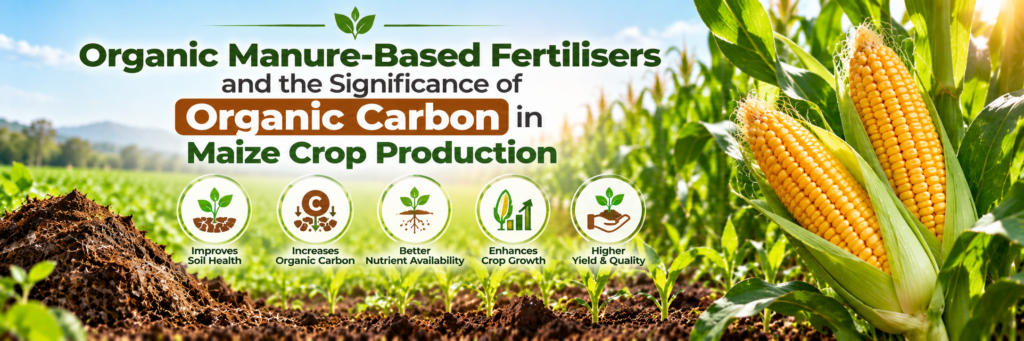
This is where organic manure-based fertilisers and organic carbon become important. Organic manures contribute nutrients and organic matter, while soil organic carbon plays a vital role in maintaining soil structure, biological activity and nutrient cycling. Together, they can form an important part of an integrated approach to maize cultivation, supporting crop development while helping maintain soil productivity over time.
Why Soil Health Matters in Maize Cultivation
Maize requires a steady supply of nutrients, particularly nitrogen, phosphorus and potassium, to support its growth and development. Nitrogen is essential for leaf development and chlorophyll formation, phosphorus supports root growth and energy transfer, and potassium contributes to water regulation and enzyme activity.
However, nutrient availability depends on more than fertiliser application alone. Soil structure, organic matter, moisture and microbial activity also influence how effectively plants can access essential nutrients.
When soil organic matter is depleted, the soil may become less effective at retaining moisture and supporting the biological processes involved in nutrient cycling. Organic manure-based fertilisers can help address these concerns by adding organic matter and supplying nutrients as the materials decompose.
For maize growers, the objective is to manage both the crop’s immediate nutritional requirements and the long-term condition of the soil in which it grows.
1. Understanding Organic Manure-Based Fertilisers
Organic manure-based fertilisers are derived from biological materials such as animal manure, composted plant residues and other suitable organic resources. Common examples include farmyard manure (FYM), vermicompost and well-decomposed compost.
These materials contribute organic matter to the soil and can supply nutrients in quantities that vary according to their source, composition and degree of decomposition.
Unlike many mineral fertilisers, which supply nutrients in readily available forms, organic manures generally release a portion of their nutrients gradually as microorganisms decompose the material. This process can contribute to nutrient cycling and support soil biological activity.
How They Benefit Maize Crops
- Supply essential nutrients: Organic manures can contribute nitrogen, phosphorus, potassium and other nutrients required for crop growth. The amount available during a particular growing season depends on the manure’s composition and the rate at which its nutrients are released.
- Improve soil structure: Organic matter can support the formation and stability of soil aggregates, helping create a more favourable environment for root growth.
- Support biological activity: Organic materials provide a source of carbon for soil organisms involved in decomposition and nutrient cycling.
- Contribute to long-term soil fertility: Regular, appropriate additions of organic matter can help maintain soil quality and replenish some of the resources used during cultivation.
For maize production, organic manure-based fertilisers are most effective when selected according to soil conditions and integrated with a balanced nutrient management programme.
2. Organic Carbon: A Foundation for Healthy Soil
Organic carbon is the carbon contained in soil organic matter, which includes decomposing plant and animal residues, microbial material and more stable organic compounds.
It is an important indicator of soil condition because it is associated with several physical, chemical and biological properties that influence crop growth.
When organic materials are incorporated into the soil, microorganisms break them down. Some of the carbon is released as carbon dioxide during decomposition, while some becomes part of the soil organic matter. The amount retained depends on factors such as climate, soil type, tillage and the nature of the organic inputs.
Why Organic Carbon Matters in Maize Cultivation
- Improves soil structure: Organic matter helps support soil aggregation, creating a more favourable balance between the solid particles and the spaces through which air and water move.
- Supports water retention: In many soils, increasing organic matter can improve the ability to retain water available to plants. The extent of this benefit varies with soil texture and other conditions.
- Contributes to nutrient retention: Organic matter can help retain certain nutrients and reduce their loss from the root zone, although the effect depends on soil properties and nutrient chemistry.
- Supports microbial activity: Organic carbon provides an energy source for many soil microorganisms involved in decomposition and nutrient cycling.
Maintaining soil organic carbon is therefore important not only for the current maize crop but also for the continued productivity of agricultural land.
3. Improving Nutrient Availability Through Organic Manures
The nutrients present in organic manures are not always immediately available to plants. Many must first undergo decomposition and mineralisation, processes through which microorganisms convert organic nutrients into forms that roots can absorb.
This gradual release can contribute to nutrient supply during crop growth. However, the timing and quantity of nutrient release depend on soil temperature, moisture, the composition of the manure and microbial activity.
For maize, this is particularly relevant because the crop needs adequate nutrition from early establishment through vegetative growth and grain filling.
Organic manures can help supply nutrients and improve the soil environment, but their nutrient content may not be sufficient to meet the entire crop requirement. Applying manure without accounting for its nutrient contribution can result in either deficiencies or excessive nutrient applications.
Soil testing and an assessment of manure quality can help farmers determine how organic inputs should be incorporated into the crop’s overall fertiliser programme.
4. Supporting Root Growth and Water Management
A well-developed root system helps maize plants absorb water and nutrients from the soil. Root growth is influenced by several factors, including soil compaction, moisture, nutrient availability and the physical condition of the growing environment.
Organic manure-based fertilisers can support root development indirectly by contributing to improved soil structure and nutrient availability.
In suitable soils, organic matter helps promote stable aggregates and favourable pore spaces, allowing roots to explore the soil more effectively. It can also contribute to water retention, which is important when rainfall is irregular or irrigation resources are limited.
These benefits do not mean that organic manure can eliminate drought stress or correct every soil constraint. Soil texture, drainage, compaction and weather conditions continue to influence crop performance.
Nevertheless, maintaining organic matter can be a valuable component of broader soil and water management practices for maize cultivation.
5. Supporting Cob Development and Grain Yield
The final objective of maize cultivation is to produce a healthy harvest with well-developed cobs and adequately filled grains.
Yield depends on several interacting factors, including the variety, plant population, weather, nutrient availability, irrigation, pest management and crop establishment.
Organic manure-based fertilisers can contribute to this process by supplying nutrients and supporting soil conditions that favour crop growth. When combined appropriately with mineral fertilisers, they can help meet crop nutrient requirements while contributing to soil organic matter.
Research published in the Indian Journal of Agricultural Sciences has examined integrated nutrient management in maize, including combinations of farmyard manure, leaf compost and mineral fertilisers. Such research highlights the potential value of combining organic and inorganic nutrient sources under suitable growing conditions.
However, yield responses vary across locations, soils and management systems. Organic manures should not be expected to produce the same results in every field, and they cannot compensate for inadequate water, unsuitable planting practices or serious pest and disease problems.
A balanced approach considers both the crop’s nutritional needs and the soil conditions required for consistent growth.
6. Integrating Organic Manures into Maize Production
Effective organic nutrient management begins with understanding the soil and selecting suitable materials.
Farmers can follow these general practices:
- Assess soil fertility: Soil testing helps identify nutrient deficiencies and determine the crop’s fertiliser requirements.
- Select suitable organic materials: Use well-decomposed farmyard manure, mature compost or vermicompost from reliable sources.
- Apply manure at the appropriate time: Incorporate organic materials according to local recommendations, allowing sufficient time for handling and soil preparation before planting where advised.
- Account for nutrient contributions: Consider the nutrients supplied by manure when calculating the crop’s total fertiliser requirements.
- Maintain balanced nutrition: Supplement organic inputs with appropriate mineral fertilisers when required to meet the crop’s nutrient demand.
- Retain suitable crop residues: Where practical and appropriate, retaining crop residues can contribute to organic matter inputs.
- Monitor soil health over time: Periodic soil testing helps track changes in organic carbon, nutrient availability and other important soil properties.
Farmers should also ensure that manure and compost are properly prepared and suitable for agricultural use. Fresh or inadequately treated materials may create handling issues, introduce weed seeds or pose food-safety and crop-management concerns, depending on their source and use.
Building Healthier Soils for Productive Maize Cultivation
For farmers, productivity begins with the relationship between the crop and the soil that supports it. Organic manure-based fertilisers contribute organic matter and nutrients, while organic carbon plays an important role in soil structure, water retention, nutrient cycling and biological activity.
When these resources are managed appropriately, they can support a more integrated approach to crop nutrition and long-term soil fertility. However, their benefits depend on the quality and quantity of the organic inputs, the soil’s existing condition and the crop’s overall nutritional requirements.
At NBCL, we recognise the importance of balanced crop nutrition and the role that suitable fertiliser solutions play in agricultural productivity. By considering organic inputs alongside other nutrient sources and sound agronomic practices, farmers can make more informed decisions about maize cultivation and soil management.
Ultimately, productive maize farming requires more than meeting the needs of a single growing season. It involves maintaining a healthy soil environment, replenishing nutrients and managing organic resources responsibly. By giving organic carbon and soil health the attention they deserve, farmers can work towards healthy crop development and more sustainable agricultural systems.