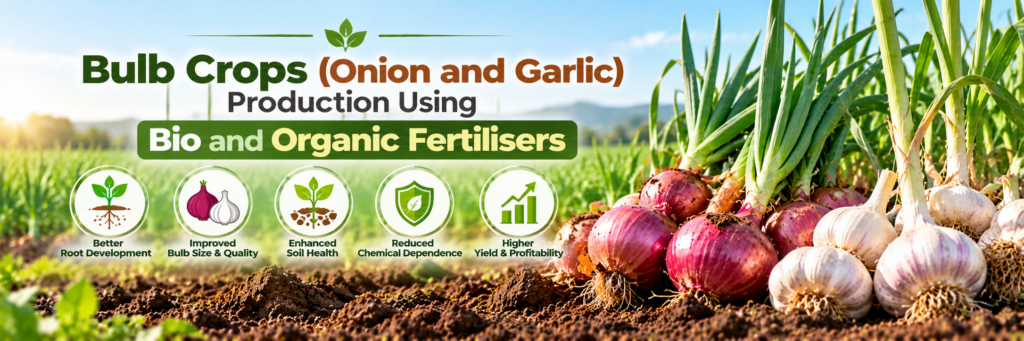
Onions and garlic may be small in size, but their importance in everyday cooking and agriculture is immense. From the onions harvested for fresh markets to the garlic bulbs stored for future use, successful production depends on more than just planting healthy seeds or cloves. The condition of the soil, the availability of essential nutrients, adequate moisture and effective crop management all influence the size, quality and marketability of the final harvest.
As farmers work towards maintaining productivity while improving soil health, biofertilisers and organic fertilisers are becoming valuable components of crop nutrition. When used appropriately, they can support nutrient availability, improve soil conditions and complement other fertiliser inputs. For bulb crops such as onion and garlic, this balanced approach can help farmers work towards healthier crops and more sustainable cultivation practices.
Why Balanced Nutrition Matters for Onion and Garlic
Onion and garlic belong to the Allium family and are cultivated for their underground bulbs. Although they share several nutritional requirements, their growth patterns and cultivation practices differ.
Both crops require a suitable balance of nitrogen, phosphorus, potassium and sulphur, along with other essential nutrients. Nitrogen supports leaf growth, which is important because healthy foliage helps the plant produce energy through photosynthesis. Phosphorus contributes to root development and energy transfer, while potassium supports water regulation and several physiological processes involved in plant growth.
Sulphur is particularly relevant to onion and garlic because it contributes to the formation of characteristic flavour and aroma compounds. An imbalance in nutrient supply, however, can affect bulb development, maturity and overall crop quality.
This is where biofertilisers and organic fertilisers can play a complementary role. Rather than relying on a single nutrient source, farmers can consider an integrated approach that supports both immediate crop requirements and the longer-term condition of the soil.
1. Understanding Organic Fertilisers in Bulb Crop Production
Organic fertilisers and manures are derived from plant, animal or other organic materials. Common examples include well-decomposed farmyard manure (FYM), compost and vermicompost.
Their value extends beyond supplying nutrients. Organic materials can contribute to soil organic matter, improve soil structure and support beneficial soil organisms. These benefits are important for onion and garlic because both crops perform best in well-drained soil that allows roots to access nutrients and moisture without prolonged waterlogging.
Incorporating suitable, well-decomposed organic manure before planting can help improve the soil environment in which roots and developing bulbs grow. Better soil structure can also support water infiltration and reduce the risk of compacted conditions.
However, organic manures vary in their nutrient content and rate of nutrient release. Fresh or incompletely decomposed manure may create problems, while excessive application can lead to nutrient imbalances. Farmers should therefore select suitable materials and apply them according to soil conditions, crop requirements and locally recommended practices.
2. How Biofertilisers Support Nutrient Availability
Biofertilisers contain beneficial microorganisms that can improve nutrient availability or support plant nutrition through biological processes. Unlike conventional fertilisers, which directly supply nutrients in specific forms, biofertilisers work through interactions between microorganisms, soil and plants.
Different microbial groups perform different functions:
- Nitrogen-fixing microorganisms: Products containing suitable organisms, such as Azotobacter or Azospirillum, can contribute to nitrogen nutrition under appropriate conditions.
- Phosphate-solubilising bacteria: These microorganisms can help make certain forms of soil phosphorus more available to plants.
- Potassium-mobilising bacteria: Suitable strains can help release potassium from certain less readily available soil sources.
The effectiveness of these products depends on factors such as microbial viability, soil conditions, moisture, temperature, application method and compatibility with other agricultural inputs.
For onion and garlic, biofertilisers can form part of a broader nutrient management programme. They should not automatically be treated as complete substitutes for all fertiliser requirements. Their role is to support nutrient availability and improve the efficiency of crop nutrition when used appropriately.
Selecting a biofertiliser suited to the intended crop and applying it according to the product label are essential steps in achieving the intended benefit.
3. Combining Organic and Biofertilisers for Better Soil Health
Organic fertilisers and biofertilisers perform different but complementary functions. Organic manures add organic matter and may supply nutrients gradually, while biofertilisers introduce beneficial microorganisms that support particular nutrient-related processes.
When combined appropriately, these inputs can contribute to an integrated nutrient management system. Research on onion and garlic cultivation has highlighted the value of combining organic manures and biofertilisers with recommended mineral fertiliser inputs, rather than depending exclusively on one source of nutrition. Such approaches can support crop productivity while helping maintain soil fertility. For example, well-decomposed farmyard manure may be incorporated during field preparation, while a suitable biofertiliser can be applied using the method recommended for that formulation. The remaining nutrient requirements can then be addressed through soil-test-based fertiliser planning.
The aim is not simply to add more inputs. It is to ensure that nutrients are available in suitable quantities and at appropriate stages of crop growth.
4. Supporting Bulb Development Through Better Nutrient Management
Bulb formation is a critical stage in onion and garlic production. Healthy foliage, adequate nutrient availability and appropriate growing conditions all contribute to the development of marketable bulbs.
In the early stages, the crop needs conditions that encourage healthy root establishment and leaf growth. As the plants develop, their nutrient requirements must be managed carefully to support bulb formation and maturation.
Organic manures can help improve the soil environment, while suitable biofertilisers may assist with nutrient availability. However, the timing and balance of nutrient application remain important. Excessive nitrogen, particularly when applied too late, may encourage continued vegetative growth and delay maturity in some circumstances.
Farmers should also avoid assuming that organic inputs alone will meet every crop requirement. Soil testing, crop history and local recommendations help determine whether additional nutrients are needed.
A well-planned nutrition programme considers the crop’s growth stage, soil fertility and expected yield, rather than applying the same inputs at the same rate to every field.
5. The Importance of Moisture and Field Management
Even a well-nourished crop can struggle when growing conditions are unsuitable. Onion and garlic require consistent moisture during important growth stages, but prolonged waterlogging can damage roots and increase the risk of disease.
Well-drained fields, properly prepared beds and irrigation suited to local conditions help maintain a favourable root environment. Organic matter can support soil moisture retention, although its effects depend on soil type and the amount and quality of material applied.
Farmers should monitor the crop regularly for weeds, pests, diseases and signs of nutrient deficiency. Weed competition is especially important to manage because it can reduce the water and nutrients available to relatively shallow-rooted bulb crops.
The choice of organic and biofertiliser inputs should therefore be part of a complete crop management plan. These inputs can support soil and plant health, but they cannot replace good drainage, suitable irrigation, quality planting material or timely crop protection.
6. Practical Steps for Using Bio and Organic Fertilisers
Farmers can improve nutrient management in onion and garlic cultivation by following a few key practices:
- Test the soil: Understand its nutrient status, pH and organic matter content before deciding on fertiliser requirements.
- Use suitable organic manure: Apply well-decomposed farmyard manure, compost or vermicompost according to local recommendations and soil needs.
- Select crop-appropriate biofertilisers: Choose products with suitable microorganisms and follow their label instructions for application and storage.
- Plan nutrient applications: Consider the nutrient contribution of organic inputs and biofertilisers alongside the crop’s remaining requirements.
- Maintain suitable moisture: Avoid prolonged waterlogging and prevent unnecessary moisture stress during bulb development.
- Monitor crop performance: Observe foliage, bulb development and field conditions, and adjust management practices where necessary.
These steps help ensure that fertiliser use is guided by crop needs rather than by the quantity of inputs applied.
Building Healthier Bulb Crops with Balanced Nutrition
Successful onion and garlic production depends on maintaining a balance between crop nutrition, soil health and sound agricultural practices. Organic fertilisers can contribute organic matter and support the physical and biological condition of the soil, while suitable biofertilisers can assist with specific nutrient-related processes. When incorporated into an appropriate nutrient management plan, these inputs can complement other fertilisers and support productive cultivation.
At Narmada Bio-chem Limited (NBCL), the focus is on supporting agriculture through a diverse portfolio of organic, bio and chemical fertilisers. The company’s product range includes organic fertilisers, biofertiliser options such as BIO NPK, Azotobacter, Azospirillum, phosphate-solubilising bacteria and potassium-mobilising bacteria, alongside chemical fertilisers and other agricultural nutrient solutions.
This range reflects the importance of considering different nutrient sources as part of a balanced crop nutrition strategy. By choosing suitable products based on crop requirements, soil conditions and recommended application practices, farmers can make more informed decisions for onion and garlic cultivation.
Ultimately, productive bulb farming begins beneath the surface. By caring for the soil while meeting the nutritional needs of the crop, farmers can work towards healthier plants, better-managed fields and more sustainable agricultural production.